

Did you know that the average resident in the Emirates discards nearly 197 kilograms of food every year, contributing to a staggering national loss of more than AED 6 billion? It’s a painful reality when you consider the high cost of imported specialty produce at your local market. You’ve likely felt the frustration of watching expensive berries or leafy greens wilt within two days due to the intense UAE humidity and heat. It often feels like you’re throwing your hard-earned money straight into the bin.
The good news is that you don’t have to accept rapid spoilage as an unavoidable part of desert life. This guide shows you exactly how to reduce food waste uae by mastering climate-specific storage and smarter shopping habits. You’ll learn how to extend the life of your groceries by up to 50% and significantly lower your monthly food spend. We’re breaking down the best ways to organize your kitchen for the 2026 season, helping you play a vital role in the UAE’s National Food Security Strategy 2051.
Key Takeaways
- Understand the impact of the UAE’s ne’ma initiative and how residents can contribute to the national goal of halving food waste by 2030.
- Discover why sourcing seasonal produce is the most effective way to ensure a longer shelf life despite the challenging desert climate.
- Master professional storage techniques, including FIFO and temperature zoning, specifically designed for small Dubai apartments and high humidity.
- Learn practical tips on how to reduce food waste uae to lower your monthly grocery expenses and save hundreds of AED each year.
- Explore how using the Shift 2 Fresh inventory model and mobile app helps you order with precision to eliminate waste before it starts.
The State of Food Waste in the UAE: Why 2026 is a Turning Point
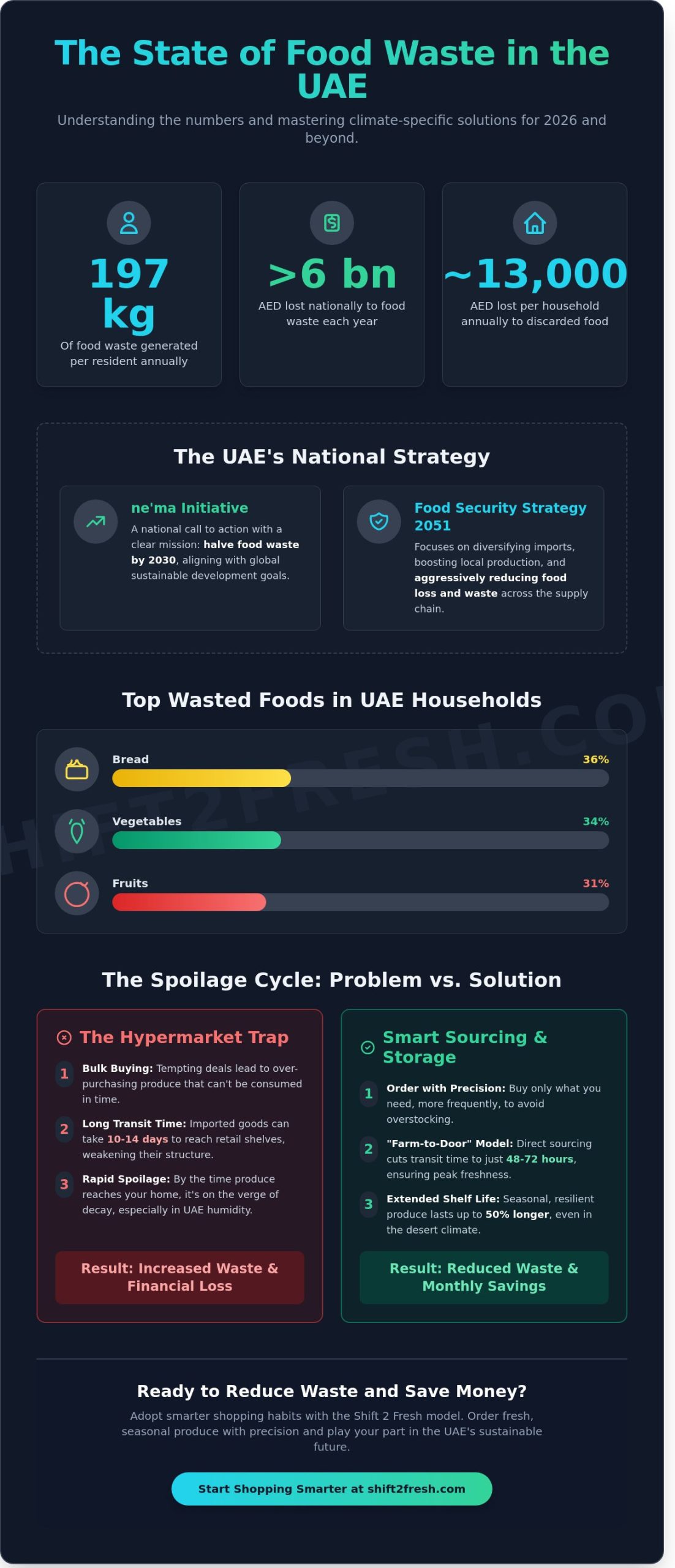
The UAE stands at a critical crossroads in its journey toward sustainability. Currently, each resident generates approximately 197kg of food waste every year. This figure represents a massive logistical and environmental challenge for a nation that imports roughly 90% of its total food supply. By 2026, the country will reach a vital midpoint in its mission to transform these habits. Central to this transformation is the ne’ma initiative. This national program seeks to halve food waste by 2030, aligning with global sustainable development goals. It’s a call to action for every household and business to rethink their relationship with what they consume.
The economic impact of this waste is staggering. Estimates suggest the average UAE household loses roughly AED 13,000 annually to food that ends up in the bin. Beyond the financial loss, the environmental cost is severe. When food rots in landfills, it releases methane, a greenhouse gas far more potent than carbon dioxide. This contributes heavily to Environmental issues in the UAE, where resource scarcity is already a primary concern. Wasting food also means wasting the immense volume of water required to produce and transport it across the globe. Learning how to reduce food waste uae isn’t just a trend; it’s a survival strategy for a desert climate.
The UAE National Food Security Strategy 2051
The 2051 strategy focuses on five key pillars: diversifying food import sources, enhancing local production, reducing loss and waste, ensuring food safety, and building resilience against crises. By 2026, the Ministry of Climate Change & Environment (MOCCAE) will implement stricter monitoring of supply chain losses. Reducing waste is non-negotiable for a nation that relies on global trade. Every discarded meal represents a vulnerability in the country’s long-term security and resource management.
Commonly Wasted Foods in UAE Households
Data indicates that bread is the most discarded item, making up 36% of household food waste. Vegetables follow at 34%, while fruits account for 31%. Delicate items, such as imported Seasonal Filipino Fruits, often spoil first because they have a shorter shelf life after long-distance shipping. Many residents fall into the ‘Hypermarket Trap.’ This happens when bulk buying deals at large retailers lead to over-purchasing. These items often expire before they can be eaten. Mastering how to reduce food waste uae starts with smaller, more frequent shopping trips to avoid this spoilage cycle.
Smart Sourcing: How Buying Seasonal Reduces Waste
Reducing kitchen scrap starts at the point of purchase. In the UAE, where imports account for roughly 85% of food consumption, the time produce spends in transit is the biggest predictor of spoilage. When you buy out-of-season items, they’ve likely spent weeks in cold storage or on cargo ships. This weakens their cellular structure. By the time they reach your kitchen in Dubai or Abu Dhabi, they’re already on the verge of decay. Learning how to reduce food waste uae effectively means prioritizing seasonal produce that hasn’t been artificially preserved for long-haul travel.
Seasonal fruits and vegetables from South Asia and the Philippines are naturally more resilient because they’re harvested during their peak growth cycles. For instance, Philippine mangoes are at their peak from March to June. Buying them during this window ensures you get fruit with a longer shelf life compared to off-season imports that require chemical ripening. Choosing “Farm-to-Door” models is a strategic move to bypass the heat of traditional wholesale markets where produce can sit for hours in non-refrigerated zones. This direct approach aligns with the national goals set by The National Food Loss and Waste Initiative (ne’ma), which aims to halve food loss by 2030 through smarter consumption habits.
- Transit Time: Direct imports can reach your door in 48 to 72 hours, whereas traditional retail can take 10 to 14 days.
- Resilience: Seasonal crops have higher nutrient density, helping them survive the UAE’s humidity.
- Seasonality: Focus on Philippine calamansi year-round, but look for South Asian root vegetables specifically during the cooler months from November to February.
The Freshness Factor of Specialty Produce
Specialty items often have specific storage needs that retail chains struggle to meet. You’ll find that Essential Asian Vegetables like Kang Kong or Bitter Gourd last significantly longer when they come from direct-import sources. Market-bought greens often suffer from “shelf-burn” due to fluctuating temperatures. To ensure quality, check for turgidity in the stems and a deep, uniform color when your delivery arrives. If a leafy vegetable feels limp, it’s already lost its moisture and won’t last more than 24 hours in your fridge.
Avoiding Over-Purchasing Through Intentional Shopping
The “Full Fridge” psychology is a major contributor to waste in UAE households. We often buy in bulk to save a few AED, but end up throwing away 25% of the haul. To fix this, use specialized shopping apps to buy exactly what your recipe requires. Instead of a generic grocery run, plan “Specialty Ingredient” weeks. If you’re buying a large quantity of Ube or Mango, plan three different recipes for those specific items. This ensures no single ingredient is forgotten at the back of the crisper drawer. If you want to start sourcing smarter today, you can explore seasonal boxes that are tailored to your actual weekly needs. This is one of the most practical ways to master how to reduce food waste uae at home.
Combatting the UAE Heat: Master Your Home Storage
Dubai summers often reach peaks of 45°C, making your kitchen a high-risk zone for rapid spoilage. If you want to learn how to reduce food waste uae, you must master the First In, First Out (FIFO) method. In a typical 70-square-foot Dubai Marina studio kitchen, shelf space is a premium. Label your containers with purchase dates using a simple masking tape system. This ensures you eat the older labneh or hummus before the fresh tub you bought yesterday. It sounds simple, but it prevents the back-of-the-fridge graveyard that accounts for a large portion of household waste.
Humidity is another silent killer for produce in the Emirates. Local humidity levels often spike above 80 percent, which causes rapid mold growth on bread and soft fruits. Use airtight glass containers to shield dry goods from this moisture. You should also be careful with ethylene gas. Keep gas-releasing fruits like bananas or apples away from sensitive greens like spinach or kale. If they sit together, your salad will wilt in less than 48 hours because the gas accelerates the ripening process to a point of decay.
Fridge Organization for Maximum Longevity
The top shelves of your fridge are the most temperature-stable, while the bottom is the coldest. Use the crisper drawer for your calamansi and ginger, but wrap them in a reusable cloth to manage moisture. You should never store onions near potatoes in a warm kitchen cabinet; onions release gases that cause potatoes to sprout and rot 30 percent faster in ambient temperatures above 25°C. To ensure maximum shelf life, the home cold chain is the process of keeping food at a constant temperature of 5°C or below from the moment it leaves the supermarket chiller until it is consumed.
Extending the Life of Tropical Produce
Tropical fruits need specific care to survive the desert climate once they leave the store. When handling longan fruit and lychees, keep them in a perforated bag in the fridge to maintain humidity without trapping liquid. To ripen green mangoes without them turning to mush, wrap them in a single layer of newspaper and store them in a dark cupboard away from the oven. If you notice your bell peppers or carrots softening, use the freezer trick. Pre-chopping and flash-freezing vegetables preserves 95 percent of their nutritional value and is a vital strategy for how to reduce food waste uae. It ensures you always have base ingredients ready for a stir-fry before the fresh produce turns into waste.
Creative Repurposing: From Scraps to Specialty Dishes
Repurposing isn’t just about saving money; it’s a culinary skill that transforms “trash” into treasure. If you’re wondering how to reduce food waste uae, start by looking at your “ugly” produce with fresh eyes. Bruised mangoes or overripe bananas shouldn’t hit the bin. These are the best candidates for smoothies, homemade jams, or traditional Filipino desserts like Mango Float. The high sugar content in overripe fruit provides a natural sweetness that fresh fruit lacks.
Don’t discard vegetable peels, herb stems, or the woody ends of asparagus. Collect these in a bag in your freezer. Once you have enough, simmer them for 60 minutes to create an authentic, nutrient-dense Asian broth. This works exceptionally well with ginger skins and scallion ends. For your wilting greens, the “End of Week” stir-fry is a foolproof strategy. Toss leftover bok choy, gai lan, or cabbage into a hot wok with garlic and oyster sauce. It clears your crisper drawer before your next Saturday grocery run.
In the UAE’s dry climate, dehydration is a practical preservation method. You don’t need a fancy machine; a low-heat oven set to 50°C works perfectly. Dry out extra bird’s eye chilies or sliced calamansi to create shelf-stable seasonings. These dried staples can last for six months, ensuring you always have spice and acidity on hand without the risk of fresh produce rotting in the fridge.
Repurposing Filipino Pantry Staples
You don’t have to waste the last bit of flavor in your jars. Use nearly-empty containers of Filipino Pantry Items by adding a splash of vinegar or oil to the jar, shaking it, and using the mixture as a quick marinade. While day-old rice is the gold standard for Sinangag, you can also press it into a pan to make crispy rice cakes. If your Pandesal has gone stale, don’t throw it away. Transform it into a rich Pandesal pudding by soaking the bread in a mixture of condensed milk and eggs before baking.
Community Initiatives: UAE Food Bank and Beyond
The UAE government has set a target to reduce food loss and waste by 50% by the year 2030 through the ne’ma national initiative. You can contribute to this goal by using the UAE Food Bank fridges. These are strategically placed in residential neighborhoods across Dubai and Sharjah, allowing you to safely donate surplus, untouched food to those in need. For scraps that truly can’t be eaten, look into local composting. Programs like “The Seed Program” in Sharjah offer residents ways to turn organic waste into soil. Understanding how to reduce food waste uae households generate is a collective effort that starts with these local community connections.
Sustainable Shopping with Shift 2 Fresh
Choosing where you buy your groceries is a primary step in learning how to reduce food waste uae residents can take today. Shift 2 Fresh operates on a lean inventory model that prioritizes speed over long-term storage. By bypassing traditional retail middlemen, we ensure that produce doesn’t sit in distribution centers for days. This direct approach aligns with the UAE National Food Loss and Waste Initiative, Ne’ma, which aims to reduce food waste by 50% by the year 2030. When you shop with a direct importer, you’re supporting a supply chain that values efficiency and sustainability.
Our mobile app is designed to help you order exactly what you need. Precise ordering prevents the bulk-buy trap that often leads to wilted greens in the back of the fridge. We’ve optimized our digital Asian Supermarket experience to provide high-quality specialty ingredients without the unnecessary waste found in large-scale physical stores. It’s about getting the right quantity at the right time.
Why Freshness is the Best Waste-Reduction Tool
The math of food waste is simple. If your spinach lasts 7 days instead of 4, you have a 75% higher chance of using it before it spoils. This extra shelf life saves you money and prevents organic matter from ending up in UAE landfills. We rely on 45 years of industry experience to select produce that’s hardy enough for the journey but harvested at its peak. Our direct-to-consumer delivery model means fewer hands touch your food. This reduces bruising and physical damage, which accounts for approximately 15% of produce waste in traditional retail settings.
- Direct Sourcing: We cut out up to three stages of the traditional supply chain.
- Optimized Cold Chain: Constant temperature monitoring ensures freshness upon arrival at your door.
- Expert Selection: Our team uses decades of data to source varieties with naturally longer shelf lives.
Getting Started with the Shift 2 Fresh App
Shopping sustainably shouldn’t be a chore. Our app includes seasonal filters so you can buy items that are currently in peak harvest, meaning they stay fresh longer in your kitchen. You can also set up recurring orders for staples like rice, noodles, or cooking oils. This helps you avoid panic-buying and over-ordering during busy weeks. It’s a practical way to master how to reduce food waste uae households face every month. By planning your pantry through our app, you eliminate the impulse purchases that often lead to waste.
Start your sustainable grocery journey with Shift 2 Fresh today and see the difference that professional sourcing makes in your kitchen.
Join the UAE’s Sustainable Food Revolution Today
Building a sustainable kitchen in the Emirates starts with small, deliberate choices. By prioritizing seasonal produce and mastering storage techniques to beat the 40°C summer heat, you contribute to the UAE’s National Food Loss and Waste Initiative (Ne’ma) goal of halving waste by 2030. Learning how to reduce food waste uae households generate isn’t just about saving money; it’s about protecting our local resources for future generations. You can transform your daily habits by shopping with partners who understand the local climate and regional supply chain. Shift 2 Fresh brings over 45 years of food industry expertise to your doorstep, offering direct imports from the Philippines and South Asia. This ensures your ingredients arrive fresh and stay usable for much longer than standard supermarket stock. You’ll also enjoy free shipping on all orders over AED 500. Start making an impact today by choosing quality over quantity and repurposing every scrap. Every meal you save helps build a more resilient food system for everyone in the Emirates. Shop fresh, seasonal produce and reduce your kitchen waste at Shift 2 Fresh. Your journey toward a zero-waste home is a powerful step for our planet’s future.
Frequently Asked Questions
What is the ne’ma initiative in the UAE?
The ne’ma initiative is the UAE National Food Loss and Waste Initiative launched in March 2022 to coordinate national efforts to halve food waste by 2030. It’s a collaboration between the Ministry of Climate Change and Environment and the Emirates Foundation. The program targets the entire food value chain, from production to consumption. By participating in ne’ma, you contribute to the national goal of creating a more sustainable food system within the Emirates.
How can I store calamansi to make it last longer?
You can make calamansi last for up to 4 weeks by storing the fruits in a sealed airtight container inside the refrigerator crisper drawer. If you leave them at room temperature, they’ll likely dry out within 7 days. For longer preservation, squeeze the juice into ice cube trays and freeze them. This method is a great way to learn how to reduce food waste uae by ensuring small citrus fruits don’t spoil.
Where can I donate surplus food in Dubai or Sharjah?
You can donate surplus food to the UAE Food Bank, which operates multiple collection fridges and centers across Dubai and Sharjah. Launched in 2017, this initiative has distributed over 35 million meals to people in need. Organizations like the Emirates Red Crescent also accept non-perishable items. Always ensure the food is within its ‘Use By’ date and stored in original, sealed packaging to meet safety standards set by local municipalities.
Does buying from an online supermarket reduce food waste?
Buying from an online supermarket reduces food waste because it allows you to check your pantry in real-time and prevents impulse purchases that lead to spoilage. Studies show that planned online shopping can cut household food waste by up to 20% compared to traditional in-store visits. Many UAE platforms also use sophisticated inventory systems to deliver fresher produce directly from temperature-controlled hubs. This digital approach is a practical step in how to reduce food waste uae.
What are the most wasted food items in the UAE?
Rice, bread, and meat are the most frequently wasted food items in the UAE, especially during festive periods and large gatherings. According to 2021 data from the Dubai Carbon Centre for Sustainable Development, food waste accounts for roughly 38% of the total organic waste in Dubai’s landfills. Prepared meals from buffets and leftover rice from home cooking make up a large portion of this volume. Managing portion sizes for these specific items can significantly lower your household’s environmental footprint.
Is it safe to eat vegetables that have started to wilt?
It’s generally safe to eat vegetables that have started to wilt, provided there’s no visible mold, slime, or foul odors. Wilting is simply a sign of moisture loss, not necessarily spoilage. You can revive greens like spinach or carrots by soaking them in an ice-water bath for 15 to 30 minutes. If they don’t crisp up, they’re still perfect for cooked dishes like soups, stews, or stir-fries where texture is less critical.
How does the UAE National Food Security Strategy 2051 affect my grocery shopping?
The UAE National Food Security Strategy 2051 affects your shopping by increasing the availability of locally grown produce through advanced agritech and hydroponics. This strategy aims to put the UAE at the top of the Global Food Security Index by 2051. You’ll notice more “Made in UAE” labels on shelves, which often have a longer shelf life due to shorter transport times. Supporting these local brands helps reduce the carbon footprint and food loss associated with long-distance imports.
What is the difference between ‘Best Before’ and ‘Use By’ dates in the UAE?
The ‘Best Before’ date refers to the food’s quality and peak flavor, while the ‘Use By’ date is a strict safety deadline. In the UAE, ESMA (Emirates Authority for Standardization and Metrology) regulations mandate these labels to protect consumers. You can often eat dry goods like pasta after their ‘Best Before’ date if they look and smell fine. However, you shouldn’t consume perishables like dairy or meat past the ‘Use By’ date, as this poses a health risk.
0 comments