

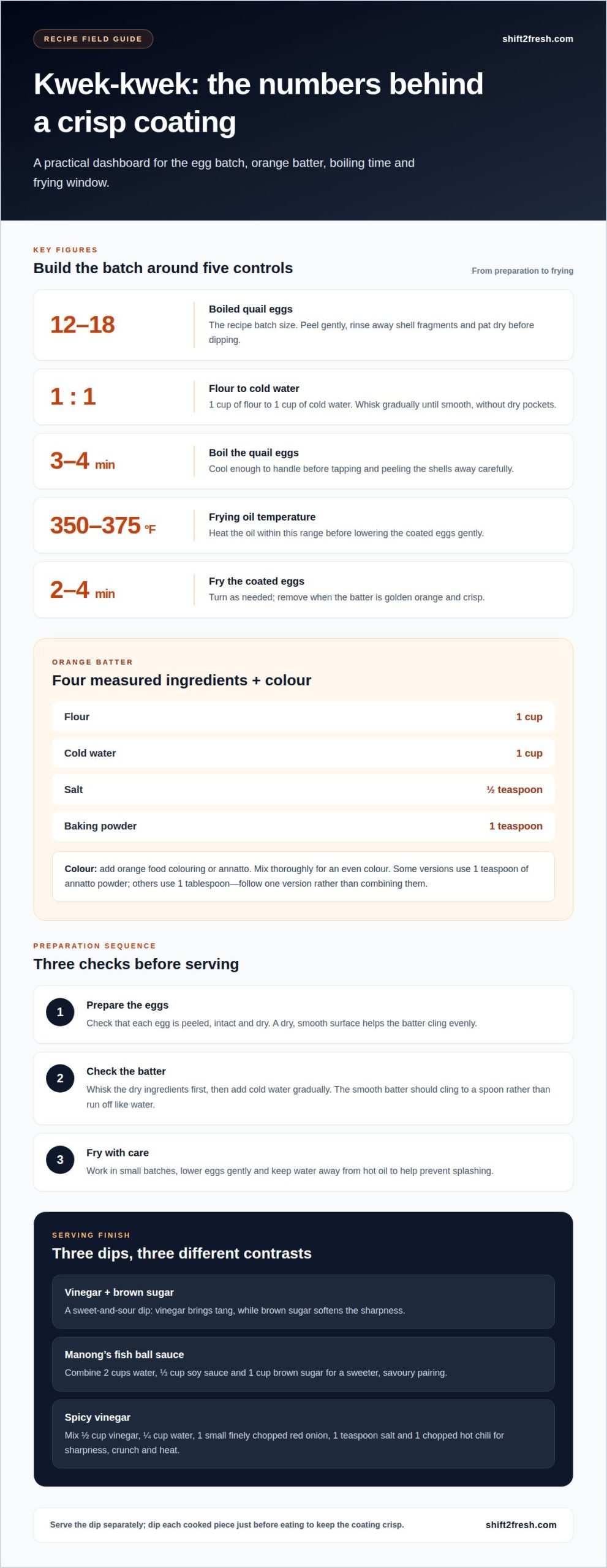
Crispy kwek-kwek starts with a well-seasoned batter and properly boiled quail eggs. The essential kwek-kwek recipe ingredients are 12 to 18 boiled quail eggs, 1 cup of flour, 1/2 teaspoon of salt, 1 teaspoon of baking powder, and 1 cup of cold water. Orange coloring gives the coating its signature hue, while frying at 350 °F to 375°F helps it crisp.
The vivid orange shell and crunchy bite make kwek-kwek appealing, but the batter needs to coat the eggs evenly without getting too thick. Get the basics right for a tasty snack that’s easy to serve with a dip.
This guide covers boiling and peeling quail eggs, mixing orange batter, and frying them in batches. You’ll also learn how vinegar dip compares with fish ball sauce, so you can choose the tangy or sweet-savory finish you prefer.
Key Takeaways
- Peel the boiled quail eggs carefully and pat them dry so the batter can cling evenly.
- Mix the coating until smooth, then adjust its thickness so it covers each egg without clumping.
- Use annatto for a naturally orange-toned batter, and mix it thoroughly for more even colour.
- Choose a sharp vinegar dip for tang or fish ball sauce for a sweeter, savoury finish.
Kwek-kwek made with boiled quail eggs
Start with boiled quail eggs, coat them in orange batter, then fry. Prepare the eggs first, since careful peeling helps the batter cling evenly.
Boil and Peel the Quail Eggs
The client’s recipe recommends boiling quail eggs for about 3 to 4 minutes. Once cool enough to handle, gently tap each shell and peel it away without tearing the white. Rinse off any shell fragments and pat the eggs dry before dipping. A dry, smooth surface helps the batter coat each egg rather than sliding off.
Prepare the Quail Egg Quantity
Set out 12 to 18 quail eggs for this batch. Check that every egg is fully peeled, with no shell fragments or cracks, before you start coating. Keep the prepared eggs together so you can work through them steadily. For tokneneng, use boiled chicken eggs and coat and fry them in the same style. Handle peeled eggs gently to keep their surfaces intact.
Set the Oil Temperature and Frying Time
Heat the frying oil to 350 °F to 375°F, then fry the coated quail eggs for about 2 to 4 minutes. Turn them as needed for an evenly crisp shell, and remove them when the batter is golden orange. For safer frying, keep water away from hot oil, lower eggs gently, and avoid crowding the pan. Small batches are easier to handle and help prevent splashing.
Other versions use different batch sizes: this kwek-kwek recipe uses 36 hard-boiled and peeled quail eggs, while this kwek kwek recipe uses 24-30 quail eggs. One method covers the quail eggs in boiling water and leaves them covered off the heat for 10 minutes; another instructs cooks to simmer the quail eggs for 5 minutes. The recipe says unpeeled hard-boiled quail eggs can be refrigerated for up to 7 days.
Orange batter ingredients
The kwek-kwek recipe ingredients for this orange coating are 1 cup of flour, 1/2 teaspoon of salt, 1 teaspoon of baking powder, and 1 cup of cold water. Add orange food colouring or annatto for the batter’s familiar colour.
- Measure the dry ingredients. Put 1 cup of flour, 1/2 teaspoon of salt, and 1 teaspoon of baking powder in a bowl. Stir them together before adding liquid so the baking powder and salt are distributed throughout the flour. This helps each quail egg receive a similarly seasoned coating instead of a patchy mix.
- Add cold water gradually. Pour in 1 cup of cold water while whisking the dry mixture. The recipe’s water-to-flour ratio is 1 cup to 1 cup. Mix until the batter looks smooth, with no dry pockets of flour. If a lump remains, press it against the bowl with the whisk rather than adding extra water, which can make the coating too thin.
- Colour and check the batter. Stir in orange food colouring or annatto until the colour is even throughout. Dip a spoon into the bowl: the batter should cling to its surface and coat it, rather than run off like water. Mix again if you see colour streaks or dry flour. Keep the batter beside the prepared eggs, then coat each egg evenly before frying.
For Filipino cooking, Shift 2 Fresh offers Filipino pantry items alongside ingredients for everyday dishes.
Other versions use 3/4 to 1 cup of water, ¼ cup or 3 tablespoons of cornstarch, ¼ teaspoon of ground pepper, 4 tspn of annatto powder, and one 8-gram packet of Magic Sarap seasoning powder.
Vinegar or fish ball sauce for serving
Serve kwek-kwek with a sharp vinegar dip or sweet-savoury fish ball sauce. Each option gives the crisp coating a different contrast.
- Mix a sweet-and-sour vinegar dip. Combine vinegar and brown sugar for a sweet-and-sour dip. Stir until the sugar dissolves, then taste and adjust the balance with more vinegar or sugar to suit your preference. Vinegar gives the dip its tang, while brown sugar softens the sharpness. Pour it into a small bowl for dipping.
- Make Manong’s special fish ball sauce. Combine 2 cups of water, ⅓ cup of soy sauce, and 1 cup of brown sugar in a saucepan. Stir as the mixture heats so the sugar dissolves and the soy sauce blends evenly. Let the sauce cook until it comes together, stirring to prevent sugar from settling on the bottom. Serve it in a separate bowl for a sweeter, savoury pairing.
- Prepare a spicy vinegar option. For a more textured dip, combine ½ cup of vinegar with ¼ cup of water, 1 small finely chopped red onion, 1 teaspoon of salt, and 1 chopped hot chili. Stir well so the salt disperses and the onion and chili are coated in vinegar. This version brings sharpness, crunch, and heat to each bite. Keep the chili in the bowl for a stronger kick.
- Choose a dip to match your preference. Choose plain vinegar and sugar for a direct tang, or serve Manong’s sauce for sweetness and soy flavour. Onion-and-chili vinegar adds bite and heat. Set out two bowls to suit different tastes, and dip each cooked piece just before eating to keep the coating crisp.
Annatto as a colouring alternative
Annatto powder gives kwek-kwek batter its orange colour without orange food colouring. Add it gradually and mix thoroughly to prevent streaks.
- Choose your annatto amount. Some versions use 1 teaspoon of annatto powder, while others call for 1 tablespoon. These are different recipe quantities, so follow one version rather than combining both. A smaller amount gives you a starting point for a lighter shade; more powder deepens the colour.
- Combine the powder with the dry mix. Whisk the annatto into the flour before adding water. This helps distribute the colour through the batter and prevents concentrated orange spots. If the powder forms small clumps, press them against the side of the bowl with a spoon, then whisk again.
- Mix in the liquid gradually. Pour cold water into the coloured flour while stirring. Scrape the bottom and sides of the bowl to incorporate all the dry flour and annatto. Check the batter in good light: an even orange colour indicates that the powder is well distributed.
- Check the coating before frying. Dip one prepared quail egg into the batter and lift it over the bowl. The coating should cover the egg without leaving bare patches. If you see streaks, stir the batter before coating the remaining eggs. Don’t add extra annatto without mixing it in thoroughly.
- Keep the Filipino street-food look consistent. The familiar orange shell makes kwek-kwek easy to recognise among Filipino street food snacks. When cooking in batches, stir the batter between dips so settled powder doesn’t change the colour of each coated egg. For Filipino pantry ingredients, browse the available selection to find items for your home cooking.
Shift 2 Fresh: Seasonal Filipino Fruits
Shift 2 Fresh can help you bring more Filipino ingredients into your home cooking after making kwek-kwek. Turn to its Seasonal Filipino Fruits for produce to enjoy alongside a snack, or browse Asian Vegetables and Filipino Pantry Items for inspiration for other meals. Mobile App Ordering offers another way to explore these grocery options in the UAE.
For kwek-kwek, batter and dipping sauce are the recipe essentials. Seasonal fruit can round out a snack spread, while pantry items and vegetables can help you plan a separate Filipino-inspired meal.
To explore the available offerings, visit shift2fresh.com or contact Shift 2 Fresh.
Build Your Next Filipino-Inspired Meal
Use your first batch to find the flavour and texture you enjoy most. When you cook it again, change one preference at a time and note what you’d keep. This simple habit helps you make the dish your own while preserving its familiar Filipino street-food inspiration.
The kwek-kwek recipe ingredients can also spark ideas for a wider Filipino-inspired meal at home. Think about what you’d like to prepare next, then plan your pantry and produce around that dish. Shift 2 Fresh can be a helpful next stop as you explore ingredients for home cooking in the UAE.
For your next kitchen project, contact Shift 2 Fresh today. Keep experimenting, enjoy the process, and make room for another delicious meal.
Frequently Asked Questions
What ingredients are used for the kwek-kwek batter?
The basic batter uses 1 cup of flour, 1/2 teaspoon of salt, 1 teaspoon of baking powder, and 1 cup of cold water. Add orange food colouring or annatto powder to colour it. Whisk the dry ingredients first, then gradually mix in the water. This helps distribute the salt and baking powder evenly before the eggs are coated.
How many eggs, flour, and annatto powder are needed for kwek-kwek?
Prepare 12 to 18 quail eggs and use 1 cup of flour for the batter. Annatto quantities differ between recipe versions: some use 1 teaspoon, while others use 1 tablespoon. Choose one amount rather than combining them, then mix thoroughly and assess the colour. The final shade depends on how much annatto you use and how evenly it’s dispersed.
How do you prepare and boil the quail eggs for kwek-kwek?
Boil the quail eggs for about 3 to 4 minutes, then cool them before peeling. Tap each shell gently and remove it without damaging the egg white. Rinse away any shell pieces and pat the peeled eggs dry before coating. This last step removes surface moisture, helping the batter cling instead of slipping off during frying.
How do you make the orange kwek-kwek batter?
Whisk flour, salt, and baking powder together. Gradually add cold water while stirring until smooth, then mix in orange food colouring or annatto powder until evenly distributed. Before coating all the eggs, dip one in the batter and check that it’s covered without the batter running off immediately. Stir again if the colour or texture looks uneven.
What dipping sauces are traditionally served with kwek-kwek?
Serve kwek-kwek with tangy vinegar dip or sweet, savoury fish ball sauce. For a simple vinegar dip, combine vinegar and brown sugar; chopped red onion and hot chili add extra bite. Fish ball sauce combines soy sauce and brown sugar for a richer flavour. Offering both gives guests a choice between a sharper and sweeter contrast.
Can chicken eggs be used instead of quail eggs in kwek-kwek?
Yes. You can coat and cook boiled chicken eggs in the same style; this version is called tokneneng. Fully prepare the eggs before dipping, then coat each one evenly. Chicken eggs are larger than quail eggs, so handle them carefully when placing them in the batter and hot oil, and avoid crowding the pan.
0 comments