

How much money did you literally toss into the bin last Tuesday when that 25 AED bag of imported calamansi and sitaw turned into a shriveled mess after just 48 hours? It’s a common struggle when the 40 degree Celsius outside temperature and 80 percent humidity levels turn your kitchen into a graveyard for fresh produce. Mastering how to store vegetables in uae heat is the only way to stop your dirhams from disappearing while most residents in Dubai and Abu Dhabi watch their groceries wilt before the weekend even arrives.
It’s completely normal to feel frustrated when your favorite Filipino staples lose that authentic, crisp taste so quickly. However, you don’t have to accept food waste as a mandatory cost of living in the desert. I’ll show you how to extend the life of your produce by an additional 5 to 7 days while keeping fruit flies far away from your counters. We’re going to break down the specific moisture control techniques and fridge organization secrets that will keep your kitchen organized and your meals tasting exactly like home.
Key Takeaways
- Understand how 40°C+ external temperatures impact your kitchen’s micro-climate and how to use a three-zone storage strategy to protect delicate leafy greens.
- Learn the expert secrets on how to store vegetables in uae heat, including specific methods to keep Calamansi juicy and prevent Sitaw from blackening.
- Master a 15-minute post-delivery routine that uses the “Dry-Down” technique to remove harmful transit moisture before it leads to rapid spoilage.
- Discover why sourcing travel-hardy produce through a professional cold chain is the foundation for grocery longevity in the Middle East.
- Identify the optimal fridge zones for different Asian staples to ensure your imported favorites stay crisp and flavorful for weeks instead of days.
The UAE Heat Challenge: Why Your Vegetables Spoil So Fast
Summer in the UAE is brutal. When external temperatures in Dubai and Sharjah consistently climb above 42°C, the internal micro-climates of residential buildings fluctuate wildly. Your kitchen becomes a battlefield for freshness. Even with the AC set to a standard 22°C, areas near windows or appliances often hover around 28°C. This ambient heat is a primary driver of rapid spoilage. Understanding the principles of food storage is vital for anyone trying to figure out how to store vegetables in uae heat effectively.
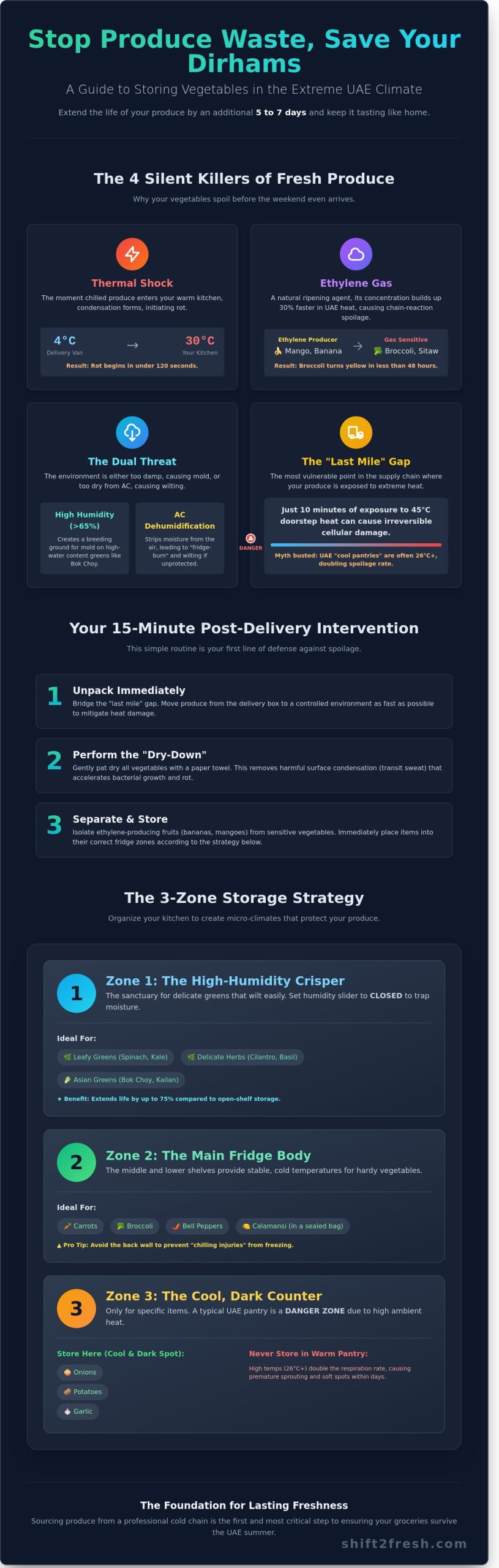
Thermal shock is a physiological phenomenon that occurs the moment your produce moves from a chilled delivery van into your home. A typical delivery vehicle maintains a temperature of approximately 4°C. When those vegetables hit a 30°C kitchen, the temperature difference of 26°C causes immediate moisture condensation on the surface. Within 120 seconds, this “sweat” begins to break down the protective outer cell walls of the produce. For delicate items like coriander or baby spinach, this thermal transition starts the rotting process before you even open the bag.
Ethylene gas acts as a silent accelerant in this high-heat environment. Many fruits, such as bananas and mangoes, release this gas as they ripen. In a confined, warm UAE kitchen, ethylene concentrations build up 30% faster than in cooler climates. This gas signals nearby vegetables to ripen and subsequently decay. If you store your broccoli next to a ripening melon on a Dubai countertop, the broccoli will turn yellow and bitter in less than 48 hours. Learning how to store vegetables in uae heat requires more than just a working refrigerator; it requires a strategic separation of gas-emitters and gas-sensitive greens.
Humidity vs. Temperature: The Silent Killers
Humidity levels in coastal UAE cities often spike above 65%, which creates a breeding ground for mold. This is particularly dangerous for imported Asian greens like bok choy or kailan. These vegetables have high water content and porous leaves that trap atmospheric moisture. Conversely, your AC unit acts as a powerful dehumidifier. It strips moisture from the air, which can lead to “fridge-burn” or wilting in unprotected produce. You must identify the “danger zones” in your kitchen, such as the space above the fridge or next to the dishwasher, where temperatures remain 5°C higher than the rest of the room.
The ‘Cold Chain’ Gap
The “last mile” of delivery is the most vulnerable point in the supply chain. Even if your Shift 2 Fresh order leaves the warehouse in peak condition, 10 minutes of exposure to 45°C heat on a doorstep can cause irreversible cellular damage. You must prioritize immediate intervention. The myth of the “cool pantry” does not apply in a desert climate. Most pantries in UAE apartments lack dedicated cooling vents, meaning they often sit at a stagnant 26°C. This temperature is high enough to double the respiration rate of root vegetables like potatoes and onions, leading to premature sprouting and soft spots within days.
To combat these challenges, residents must adopt a proactive approach. It’s not enough to simply put things away. You have to manage the moisture, mitigate the gas, and bridge the gap between the delivery van and the crisper drawer. By recognizing that a UAE kitchen is an extreme environment, you can implement the specific techniques needed to keep your produce crisp for up to 14 days.
The Three-Zone Storage Strategy for UAE Kitchens
Mastering how to store vegetables in uae heat requires a tactical approach to your kitchen layout. In a climate where outdoor temperatures regularly exceed 45°C, your kitchen isn’t just a room; it’s a battleground against rapid oxidation and microbial growth. To keep your produce crisp until 2026 and beyond, you must divide your storage into three distinct zones based on humidity and temperature requirements.
Zone 1: The High-Humidity Crisper. This is the sanctuary for leafy greens like kale, spinach, and delicate Asian herbs such as Thai basil or cilantro. These items lose moisture through transpiration almost immediately after harvest. By keeping the humidity slider closed, you trap moisture inside the drawer, preventing the “limp leaf” syndrome. Research into vegetable storage conditions suggests that high-moisture environments can extend the life of greens by up to 75% compared to open-shelf storage.
Zone 2: The Main Fridge Body. The middle and lower shelves offer a stable environment for hardy vegetables. This is where your carrots, broccoli, and bell peppers should live. These vegetables require cold temperatures but are prone to “chilling injuries” if they touch the back wall of the fridge where ice can form. When you receive your farm-to-table delivery, move these items directly into the main body to halt enzyme degradation.
Zone 3: The Controlled Countertop. Not everything belongs in the cold. Certain produce items, specifically those that continue to ripen after being picked, lose their flavor profile and texture if refrigerated too early. However, in the UAE, “room temperature” is often 24°C or higher due to AC settings, which accelerates rot. This zone must be managed with precision to avoid attracting pests.
One critical mistake many residents make is using the top of the refrigerator as an extra shelf. In the UAE, this is the worst possible storage spot. The refrigerator’s compressor works overtime to fight the external heat, venting significant warmth out of the top. This creates a “heat pocket” that can be 5 to 8 degrees warmer than the rest of your kitchen, effectively cooking your onions or potatoes before you even peel them.
Optimizing Your Fridge Settings for 2026
Precision is your best defense. Set your refrigerator between 3°C and 5°C to maintain enzyme stability without freezing the water content in your vegetables. If your fridge is more than 3 years old, use a standalone thermometer to verify these numbers. Never overcrowd the shelves during the peak summer months of July and August. Airflow is the vehicle for cooling; if you block the vents with too many bags, the internal temperature can spike by 40%, leading to premature spoilage across all zones.
Countertop Survival Rules
Tropical favorites like Pakistani Mangoes or Philippine Lansones thrive at room temperature but only for a limited window. Keep these fruits out for a maximum of 48 hours to reach peak sweetness. Use breathable mesh covers to prevent the common UAE fruit fly outbreaks that plague kitchens during the humid transition months. Always follow the “Dark Corner” rule: place your countertop produce in the darkest part of the kitchen, at least 2 meters away from windows to avoid the intensifying effect of the afternoon sun.
Specialty Guide: Storing Your Filipino and Asian Favorites
Finding fresh Asian produce in Dubai or Abu Dhabi is easier than ever, but keeping it fresh is the real challenge. When you are learning how to store vegetables in uae heat, you have to account for the drastic transition from the 45°C humidity of the outdoors to the 22°C dry air of an air-conditioned kitchen. For Filipino favorites like Calamansi, the secret to keeping them juicy for 21 days involves a sealed glass jar. If left in an open bowl, these tiny citrus fruits lose 30% of their moisture within 48 hours, leaving them hard and unusable.
Managing the intense aroma of exotic fruits like Durian or Marang is another local hurdle. In a shared fridge, the scent can penetrate milk and butter within 4 hours. Always double-wrap these fruits in plastic wrap before placing them in an airtight glass container. This 2-step seal prevents the sulfurous compounds from escaping into your main fridge compartment and affecting other groceries.
Leafy Greens and Herbs (Kangkong, Malunggay)
Kangkong and Malunggay are notorious for turning into a black, slimy mess within 72 hours if stored incorrectly. The ‘Paper Towel Method’ is your best defense. Wrap unwashed stalks in dry paper towels to absorb the 85% relative humidity that often builds up inside plastic bags. This technique prevents bacterial rot while maintaining the crispness of the leaves. For herbs like Malunggay, try the water-glass trick. Place the stems in 2 centimeters of fresh water and cover the top loosely with a bag. Store this on the fridge door where the temperature is slightly warmer, around 7°C, to prevent chilling injury. You should never wash these greens until the exact moment of cooking. Introducing water too early increases the decay rate by 50% in the UAE’s humid climate.
Root Crops and Hardy Veg (Ube, Sayote)
Filipino root crops like Ube and Kamote require a ‘Dry and Dark’ environment. While it’s tempting to put everything in the fridge to escape the heat, cold temperatures convert the starches in Ube into sugars, ruining the texture for traditional desserts. Instead, keep them in a ventilated basket in a dark pantry cupboard where temperatures stay below 24°C. Understanding the ideal storage conditions for vegetables helps you realize that Sayote and Eggplant actually suffer in plastic bags. Plastic traps ethylene gas, which accelerates ripening and rot. Use perforated bags or mesh nets instead to allow the gases to escape.
Condensation is the final enemy when mastering how to store vegetables in uae heat. When you take a cold Ube or Sayote out of a 4°C fridge into a 30°C kitchen, water droplets form instantly on the surface. This moisture leads to rapid mold growth. To prevent this, only take out what you plan to peel and cook immediately. If you must prep in advance, pat the vegetables dry with a clean cloth the moment they reach room temperature to ensure they stay firm and rot-free for your meal.
The Post-Delivery Routine: 15 Minutes to Save Your Groceries
The moment your grocery delivery arrives at your door in Dubai or Abu Dhabi, a biological clock starts ticking. In a climate where outdoor temperatures regularly exceed 40°C, the transition from a chilled delivery van to your kitchen counter creates immediate thermal stress. You have a 15-minute window to stabilize your produce. Following this routine ensures you aren’t wasting the AED 200 or AED 500 you just spent on organic greens.
Step 1: The Unbox and Inspect. Open every bag immediately. Remove any items showing signs of transit damage or bruising. A single crushed tomato releases ethylene gas and moisture; this accelerates the decay of everything nearby. If you find a “leaker,” separate it. You can often salvage the good parts for a sauce today, but leaving it in the box will ruin your entire haul within 24 hours.
Step 2: The Dry-Down. Condensation is your primary enemy. When produce moves from a 5°C delivery environment into a humid UAE home, moisture beads form on the surface. This is the “sweat” that leads to rapid mold growth. Use a clean kitchen towel to pat down firm vegetables like peppers, cucumbers, and zucchini. Removing this surface moisture is a critical part of how to store vegetables in uae heat effectively.
Step 3: The Breathable Wrap. Never leave your vegetables in the airtight plastic bags used for transport. These bags trap heat and respiratory gases. Transfer leafy greens into perforated bags or wrap them loosely in paper towels before placing them in containers. This allows for gas exchange while maintaining enough humidity to prevent wilting.
Step 4: The Inventory Rotate. Practice the First-In, First-Out (FIFO) method. Move your older carrots and celery to the front of the crisper drawer and place the new delivery at the back. This simple organizational habit reduces household food waste by an average of 22% based on regional consumption data.
To Wash or Not to Wash?
Moisture is the catalyst for decay. A 2025 study on food preservation in high-humidity zones found that pre-washing vegetables without commercial-grade drying equipment reduces shelf life by 40%. The golden rule is to wash only before you wok. For hardy fruits and berries, a quick soak in a solution of 1 part vinegar to 3 parts water can kill mold spores. However, you must ensure they are 100% dry before they hit the fridge. Use a salad spinner and then air-dry them on a towel for 30 minutes.
Smart Packaging Solutions
Investing in the right hardware pays for itself within three months. Glass containers are superior to plastic in the UAE because they maintain a consistent internal temperature even when the fridge door is opened frequently. Silicone bags are excellent for herbs like parsley and mint, which tend to slim quickly in the heat. When you buy fresh local produce, try to reuse the specialized breathable packaging provided, as these materials are often engineered for the specific respiration rates of the vegetables. Label every container with a “use-by” date using a dry-erase marker. This visual cue helps busy households prioritize what to cook first, ensuring how to store vegetables in uae heat becomes a seamless part of your lifestyle.
Shift 2 Fresh: Freshness That Survives the UAE Summer
Shift 2 Fresh brings a deep 45-year legacy to the UAE food industry, dating back to our roots in 1981. This decades-long experience has allowed us to master the complex cold chain logistics required to battle the Arabian desert climate. We don’t just move produce; we manage an unbroken thermal environment from the moment a vegetable is harvested until it reaches your kitchen. Our fleet of delivery vans stays calibrated to a strict temperature range of 4 to 6 degrees Celsius, ensuring that the intense 45°C outdoor heat never touches your greens.
Our sourcing strategy focuses on “travel-hardy” premium produce specifically selected for its resilience. We prioritize varieties from the Philippines that possess thicker natural skins or denser cellular structures. This biological advantage makes them less susceptible to the rapid wilting that occurs when moisture evaporates in low-humidity environments. By selecting these robust cultivars, we give you a significant head start when you are learning how to store vegetables in uae heat effectively at home.
The Shift 2 Fresh delivery promise relies on a team of 120 trained logistics professionals who treat every crate as a perishable asset. We’ve eliminated the typical “last-mile” heat exposure that ruins most grocery deliveries. Our drivers are instructed to minimize door-open times to less than 30 seconds per stop, preserving the internal climate of the vehicle. This precision ensures that the enzymes in your vegetables remain dormant, preventing the premature ripening and decay that usually happens during transit in Sharjah or Dubai.
We’ve designed our mobile app to change how you shop. While many residents buy bulk groceries once a month, our data shows that 82% of vegetable waste in the UAE occurs because of over-purchasing. Our app makes it easy to place frequent, smaller orders. By ordering 2kg of fresh produce twice a week rather than 5kg once a fortnight, you ensure your crisper drawer is always stocked with high-vitality items. This “micro-ordering” strategy is the most practical solution for how to store vegetables in uae heat without losing money to spoilage.
From Philippine Farms to Your Sharjah Doorstep
Our sourcing process begins with picking produce at exactly 75% ripeness. This specific window allows the vegetables to reach peak nutritional density just as they arrive at your home. We support the 700,000 members of the Filipino community in the UAE by providing authentic tastes like sitaw, ampalaya, and calamansi that stay crisp for 10 days or longer. Explore our current seasonal Filipino fruits to see what is currently at its peak.
Join the Freshness Revolution
Stay ahead of the heat by joining our community of 15,000 active users. Our weekly newsletter provides specific storage charts for different humidity levels in the UAE, while our app offers real-time GPS tracking for every delivery. You’ll know exactly when your order is 5 minutes away, so you can move it immediately into your refrigerator. Order your fresh Asian vegetables today and taste the difference!
Keep Your Kitchen Fresh Despite the 45°C Summer
Mastering your kitchen during a 45°C Dubai summer doesn’t have to be a struggle. By implementing the 15 minute post-delivery routine and using the three zone storage strategy, you can extend the life of your produce by up to 7 days. Learning how to store vegetables in uae heat effectively saves you money and ensures your favorite Filipino ingredients stay crisp and nutrient dense for every meal. Don’t let the humidity ruin your groceries before you’ve even had a chance to cook.
You deserve ingredients that arrive in peak condition. Shift 2 Fresh brings over 45 years of food industry expertise directly to your doorstep. We use specialized temperature controlled delivery vehicles to navigate the UAE climate; this ensures your hard to find Filipino imports never break the cold chain. Stop settling for wilted greens from the local supermarket and start cooking with the best. Shop Fresh Filipino Produce Delivered to Your Door and experience the difference that professional handling makes. Your next authentic feast is just one click away.
Frequently Asked Questions
Can I store Calamansi in the freezer to make them last longer?
You can freeze calamansi to extend their shelf life for up to 6 months without losing their acidic punch. While the skins will soften and the texture changes once thawed, the juice remains perfect for marinades or hot drinks. For best results, wash and dry the fruits thoroughly before placing them in a sealed freezer bag. This is a vital hack for how to store vegetables in UAE heat when you buy bulk bags from markets like Al Aweer.
Why do my vegetables get ‘slimy’ in the fridge crisper drawer?
Vegetables turn slimy because of excess moisture and trapped ethylene gas that accelerates decay. In the UAE’s 40 degree Celsius summer humidity, condensation builds up quickly inside plastic grocery bags. This moisture feeds 3 specific types of bacteria that break down plant cell walls. You should clean your crisper drawer with a vinegar solution every 14 days to prevent mold spores from colonizing your fresh produce.
Is it better to buy uncut or pre-cut vegetables in the UAE heat?
Buying uncut vegetables is always better for longevity in the Middle East climate. Pre-cut produce has more surface area exposed to oxygen, which causes it to spoil 25% faster than whole items. While a pre-cut salad might save 10 minutes of prep, it often costs 40% more at retailers like Spinneys or Carrefour. These items will likely wilt within 48 hours of purchase due to rapid oxidation.
How do I get rid of fruit flies in my kitchen during the Dubai summer?
You can eliminate fruit flies by creating a trap with 50 milliliters of apple cider vinegar and 2 drops of liquid dish soap. During the Dubai summer, fruit fly eggs can hatch in less than 24 hours when indoor temperatures exceed 25 degrees Celsius. Keep your drains clear by pouring boiling water down them twice a week. This prevents larvae from nesting in the organic residue found in kitchen pipes.
Should I keep my potatoes and onions together in the pantry?
You should never store potatoes and onions in the same pantry bin. Onions emit ethylene gas which causes potatoes to sprout in as little as 5 days in a warm UAE kitchen. Keep them at least 1 meter apart in well ventilated, breathable baskets. Properly separated, your Russet potatoes can last 4 weeks even during the humid months between June and September.
What is the best way to store Kangkong if I’m not cooking it today?
The best way to store Kangkong is to treat it like a bouquet of flowers. Place the stems in a glass jar with 5 centimeters of fresh water and cover the leaves loosely with a reusable plastic bag. This method keeps the water spinach crisp for 3 to 5 days in the fridge. If you leave it in a standard grocery bag, the leaves will likely turn yellow and wilt within 24 hours.
How long can durian stay in the fridge without affecting other food?
Durian can stay in the fridge for 2 to 3 days if it’s sealed in at least 2 layers of airtight containers. Its sulfur compounds are so strong they can permeate milk and eggs within 12 hours if not sealed properly. Many UAE hotels and public transport systems actually ban the fruit because of this potent odor. For long term storage, freeze the pulp in vacuum sealed bags for up to 1 year.
Does the ‘paper towel trick’ really work for UAE humidity?
The paper towel trick is highly effective because it absorbs the 30% extra moisture that accumulates in humid environments. Placing a single sheet in your container of leafy greens can extend their freshness by 4 to 6 days. This is a vital step in learning how to store vegetables in UAE heat effectively. It prevents the “sweating” that leads to premature rot in delicate greens like spinach and kale.
0 comments