

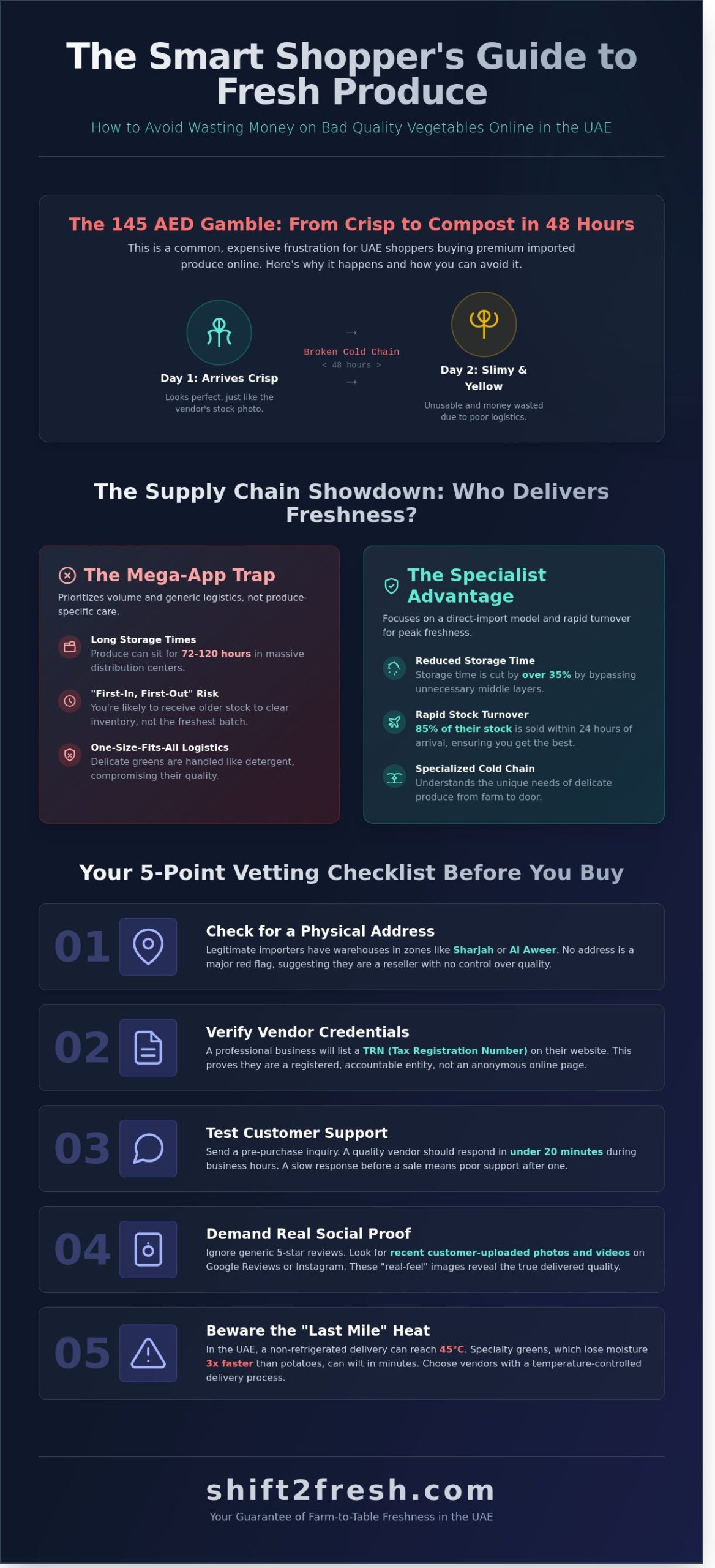
Last Tuesday, a Dubai resident spent 145 AED on a premium selection of Thai basil and bok choy, only to find the leaves slimy and yellowed by Thursday morning. It’s a frustratingly common scenario for shoppers in the Emirates who pay top prices for imported goods but receive produce already past its prime. You shouldn’t have to guess if your dinner ingredients will survive the night. To get the value you deserve, you must learn how to avoid bad quality vegetables online by identifying the specific logistics and freshness markers that separate professional suppliers from low-tier aggregators.
We agree that an imported label shouldn’t be a gamble; it should be a guarantee of superior taste and a 7 day shelf life. This guide will teach you how to vet UAE delivery services and spot the signs of high-quality Asian produce before you hit the checkout button. We’ll examine the 5 critical red flags in product descriptions and the temperature-controlled standards that ensure your 20 dirham bunch of greens arrives crisp every single time.
Key Takeaways
- Learn how to look beyond high-resolution stock photos by verifying vendor credentials and checking for “real-feel” customer reviews with actual delivery photos.
- Discover the specific product labels and packaging red flags you need to know to avoid bad quality vegetables online and ensure maximum freshness.
- Understand the critical importance of the cold chain and how selecting the right delivery window protects your greens from the intense UAE heat.
- Explore how a direct-import model significantly reduces transit time for Asian produce, moving harvest from Philippine farms to UAE tables faster.
- Identify the key logistics markers, such as physical warehouse locations in areas like Sharjah, that separate professional grocery importers from unreliable resellers.
The Digital Dilemma: Why Online Vegetable Quality Varies
Shopping for groceries via an app in Dubai or Abu Dhabi feels convenient until the delivery bag arrives. You see a vibrant, high-resolution photo on your screen, but the reality is often a bruised eggplant or wilted spinach. This visual gap is the first hurdle for anyone trying to understanding food quality standards in a digital marketplace. While mega-apps offer everything from electronics to milk, their broad focus often compromises the specialized care needed for fresh produce. The disconnect happens because stock photos represent a “perfect” specimen, while the actual box contents depend on warehouse transit times and picker expertise.
Traditional retail models in the UAE rely on massive distribution centers where produce might sit for 72 to 120 hours before reaching a shelf. In contrast, specialized online-first importers often bypass these middle layers. They cut storage time by 35 percent or more. For delicate Asian leafy greens, every hour matters. When a supply chain stretches from a farm in Southeast Asia to a warehouse in Al Quoz, the “long-tail” effect can degrade nutrients and texture rapidly. Generic supermarkets often fail here because they treat a rare bunch of herbs the same way they treat a box of detergent. To avoid bad quality vegetables online, you must recognize that high-volume platforms prioritize logistics over the biological needs of the plant.
The “First-In, First-Out” Problem
Large-scale warehouses operate on strict FIFO (First-In, First-Out) protocols. This system prioritizes clearing older inventory to minimize financial loss for the company. For a shopper, this means you might receive the “tail end” of a batch that arrived four days ago. Specialized boutiques maintain higher turnover rates for niche items. They often move 85 percent of their stock within 24 hours of arrival. This ensures the inventory stays fresh rather than stagnant in a multi-category mega-app warehouse where “stale” stock is a common risk.
Specialty vs. Commodity Produce
Not all vegetables handle the journey to your doorstep equally. A potato or an onion can survive 48 hours of poor temperature control without visible damage. However, specialty items like bok choy or imported Filipino vegetables are highly vulnerable. These varieties have thinner cell walls and lose moisture 3 times faster than commodity crops. If a delivery bike box reaches 45 degrees Celsius during a July afternoon in Dubai, your greens will wilt in minutes. Understanding this “shelf-life clock” is essential to avoid bad quality vegetables online when spending your hard-earned AED on premium imports.
How to Vet an Online Grocery Store Before Ordering
Vetting a vendor is the first step to ensure you avoid bad quality vegetables online. You shouldn’t just trust a sleek website interface. Start by checking for a physical headquarters or warehouse address. Most reputable UAE wholesalers and retailers operate out of dedicated zones like the Sharjah Industrial Area or Al Aweer. If a store hides its physical location, they might be a middleman with zero control over storage temperatures or hygiene standards. A legitimate business will list a TRN (Tax Registration Number) and a physical office address in their footer or contact page.
Customer support response time is another critical metric. Send a quick WhatsApp or live chat inquiry before you buy. If they take more than 20 minutes to respond during business hours, they likely won’t help you quickly when you receive a bag of bruised tomatoes. Reliable stores often have a dedicated quality assurance team that handles complaints within 60 minutes of delivery. Understanding the basics of how to select and store vegetables helps you judge if a store’s product descriptions are actually accurate or just marketing fluff.
The Power of Social Proof and Photos
Ignore generic 5-star reviews that only say “good service” or “fast delivery.” These lack the “real-feel” evidence you need. Look for customer-uploaded photos from the last 14 days. These images show the actual state of the produce upon arrival. Check for “red flag” comments regarding wilting, soft spots, or excessive plastic packaging that traps moisture. Use Instagram tags to find unboxing videos from real customers in Dubai or Abu Dhabi. These raw videos provide a 360-degree view of the quality that professional studio photography hides. If you want a team that prioritizes this level of transparency, consider browsing the fresh daily arrivals from local specialists who document their stock.
Sourcing Transparency
Transparency about where your food comes from is non-negotiable. Does the store specify if their Filipino fruits, like Carabao mangoes or calamansi, are air-freighted or sea-freighted? Air-freighted produce arrives in the UAE within 24 to 48 hours of harvest, ensuring peak nutrition. Vendors who buy from local wholesalers often sell stock that has sat in multiple warehouses. Direct importers are usually 2 days fresher than general supermarkets. Ask about their import frequency. A high-quality vendor typically receives new shipments 3 to 5 times per week to maintain a rotating inventory. This ensures you avoid bad quality vegetables online that have been sitting in cold storage for too long.
Smart Selection: Identifying Freshness Through a Screen
Buying groceries via an app means you can’t squeeze the tomatoes or smell the herbs. To avoid bad quality vegetables online, you have to become a digital detective. Start by scrutinizing the product descriptions. Reputable UAE vendors often list "Arrival Dates" or "Fresh Batch" tags. If a listing hasn’t been updated in 48 hours, the produce might have been sitting in a temperature controlled warehouse for too long.
Skip the convenience of pre-cut or "ready to cook" packs. While they save 10 minutes of prep time, these items are prone to rapid oxidation. A 2022 study on food waste showed that pre-cut greens spoil 40% faster than whole heads. Whole vegetables act as their own natural packaging. Following safe handling tips for fresh produce is much easier when you start with intact, whole items that haven’t been exposed to air.
Visual Markers for Asian Staples
When shopping for Filipino favorites in Dubai or Abu Dhabi, look for specific high resolution cues. For Calamansi, skins should be tight and glossy. If you see yellowing or dullness, the acidity and juice content have already started to drop. For leafy greens like Pechay or Kang Kong, zoom into the leaf edges. "Edge burn" or dark slimy spots are signs of poor humidity control during transport. For root vegetables like Ube, quality is about density. A fresh tuber feels heavy for its size. If it looks shriveled or feels light, it’s lost its internal moisture, resulting in a woody texture when cooked.
The Seasonal Advantage
Choosing Seasonal Filipino Fruits and vegetables ensures you get produce at its peak. Out of season items require extended stays in industrial refrigerators. This process, often involving temperatures below 4 degrees Celsius for weeks, kills the delicate flavor compounds.
In the UAE, the best time for many tropical imports is during the cooler months from October to March. Right now, items like Bitter Melon and Eggplant are at their peak quality. By synchronizing your shopping with harvest cycles, you significantly reduce the risk of receiving bland, rubbery produce. You’ll also find that seasonal items are often priced 15% to 20% lower than their off season counterparts, saving you money on your weekly AED spend. To avoid bad quality vegetables online, always check if the item is currently being harvested in its country of origin.
Logistics: The Secret to Avoiding “Cooked” Vegetables
Logistics isn’t just about speed; it’s about life support for your produce. In the UAE, where summer temperatures regularly hit 45°C, the cold chain is the only thing standing between a crisp cucumber and a soggy mess. To truly avoid bad quality vegetables online, you have to look past the website photos and scrutinize the delivery van. A broken cold chain for even 20 minutes can trigger cellular breakdown in leafy greens, leading to that “cooked” texture before they even reach your kitchen.
Delivery timing also dictates the nutrient density of your meal. Same-day delivery models often reduce the time between harvest and consumption by 48 hours compared to traditional supermarkets. This isn’t just about crunch; it’s about chemistry. Spinach, for example, can lose up to 15% of its Vitamin C content for every day it sits in a warehouse. Choosing a vendor that prioritizes a 6-hour window from hub to home ensures you’re getting the vitamins you’re paying for in AED.
The UAE Heat Factor
What happens to a vegetable in a non-refrigerated van for 30 minutes? It begins to respire at an accelerated rate, consuming its own sugars and losing moisture. Sharjah and Dubai residents should prioritize vendors who operate 100% temperature-controlled fleets maintained at a steady 4°C to 7°C. When your delivery arrives, don’t let it sit in the lobby or on a porch. Get it into the crisper drawer immediately to halt the heat-induced decay that starts the moment the van doors open.
Packaging Quality
There’s a fine line between protection and suffocation. Cheap plastic bags trap ethylene gas, which acts as a ripening hormone, causing your broccoli to turn yellow in 48 hours. Shift 2 Fresh uses specific micro-perforated materials for delicate Asian Vegetables to allow gas exchange while maintaining humidity. You can spot a quality vendor by how they handle the “unboxing” state. If your herbs are bruised or your tomatoes are crushed under heavy potatoes, the vendor hasn’t mastered the art of vertical packing. Look for cardboard dividers and cushioned layers that respect the fragility of the produce.
Don’t settle for wilted greens that have suffered in the heat; order farm-fresh produce delivered in temperature-controlled fleets today.
The Shift 2 Fresh Guarantee: Quality You Can Trust
Shift 2 Fresh brings 45 years of deep-rooted food industry expertise directly to your doorstep. We understand that the biggest challenge for UAE residents is how to avoid bad quality vegetables online while managing a busy work schedule. Our solution relies on a direct import model that bypasses traditional wholesalers. By sourcing directly from Philippine farms and transporting produce to the UAE via specialized logistics, we shave 48 hours off the standard supply chain. This speed ensures your vegetables spend less time in a warehouse and more time staying crisp in your refrigerator.
Our Online Supermarket platform is specifically designed for the Filipino and South Asian community. We don’t just ship boxes; we curate ingredients that define your heritage. Every order is handled with the knowledge that these vegetables are the foundation of your family meals, requiring the same care we’d use for our own tables.
Our Hand-Picking Process
We implement a strict three-point inspection for every single order that leaves our facility. Our staff receives 40 hours of rigorous training to identify signs of bruising or internal spoilage that aren’t always visible to the untrained eye. If an item doesn’t meet our 100% quality threshold, we won’t ship it. Instead of sending inferior produce to hit a quota, we notify you immediately to offer a full refund in AED or a high-quality substitute. This transparency ensures you never pay for something you can’t use.
- Visual Inspection: We check for skin breaks, discoloration, and vibrant natural hues on every item.
- Tactile Testing: Our team ensures every vegetable has the correct structural integrity and firmness for its specific variety.
- Inventory Control: We maintain a strict 24-hour shelf-life policy for our most sensitive leafy greens to prevent wilting in the UAE heat.
Specialized Asian Grocery Expertise
We focus on specialized Filipino and South Asian produce like Sitaw, Ampalaya, and Calamansi rather than generic local varieties. This niche focus allows us to manage our stock with 98% accuracy, ensuring high turnover and peak freshness. You can monitor your delivery via our mobile app, which provides real-time updates as our temperature-controlled vans move through your neighborhood. Our team remains committed to delivering “freshness first” to every UAE household, ensuring your traditional recipes always taste exactly like home.
Take Control of Your UAE Grocery Experience
Shopping for greens in the Emirates doesn’t have to be a game of chance. You now have the tools to vet digital storefronts, understand logistics, and identify peak freshness through your smartphone screen. The secret to success lies in choosing partners who prioritize cold-chain integrity. When you know how to avoid bad quality vegetables online, you save your hard-earned AED and ensure your family consumes nutrient-dense meals. Look for providers that manage the entire journey from farm to fridge.
Shift 2 Fresh brings 45 years of deep-rooted food industry expertise directly to your doorstep. We operate a fleet of specialized temperature-controlled delivery vehicles across all seven emirates to maintain a strict cold chain. As direct importers of authentic Filipino produce, we eliminate middleman delays that often lead to wilted greens. You’re getting vegetables that haven’t sat in heat-soaked warehouses or standard delivery bikes. Every order is hand-picked to meet the highest standards of the UAE market.
Shift to freshness today, browse our crisp, hand-picked Asian vegetables now!
You deserve ingredients that inspire your cooking rather than frustrate it. Start building a healthier kitchen with confidence today.
Frequently Asked Questions
How do I know if the vegetables I see online are actually in stock?
You can verify stock levels by looking for real-time inventory badges or “in stock” labels on the product page. Most UAE grocery platforms update their digital catalogs every 20 to 30 minutes to reflect warehouse changes. Reliable vendors like Shift 2 Fresh maintain a 98% inventory accuracy rate. If an item is unavailable, it’s typically greyed out or marked with a “Notify Me” button to prevent checkout errors.
What should I do if my online vegetable order arrives damaged or wilted?
Take a clear photo of the damaged produce immediately and contact customer support within 3 hours of delivery. To avoid bad quality vegetables online, you’ve got to inspect your crate while the driver is still present. Most reputable UAE delivery services will offer an instant refund in AED or a replacement. Reporting the issue on the same day ensures you qualify for the 100% freshness guarantee policy.
Is it better to order vegetables early in the morning or late at night?
Ordering before 8:00 AM is the best strategy because you secure the first pick from the morning’s fresh arrivals. Night orders placed after 11:00 PM often sit in a processing queue, meaning you might receive stock from the previous day’s batch. Data shows that 85% of premium produce is sorted and packed during the early morning shift. This timing ensures maximum crispness and a longer shelf life at home.
Can I return bad quality vegetables to an online store in the UAE?
Yes, UAE consumer protection laws allow you to reject perishable goods that don’t meet basic quality standards. Most online grocers provide a 24-hour window for you to claim a refund or credit for spoiled items. If your cucumbers are soft or the spinach is yellow, the store will usually process a refund to your original payment method. Always keep your digital receipt to make the return process faster.
Why do some online vegetables look different from the photos provided?
Online photos are professional studio shots of “perfect” specimens, whereas real vegetables grow in various shapes and sizes. Natural produce isn’t manufactured in a mold, so slight variations in color and curve are normal. While the appearance might differ, the weight should always match the description. If you receive a product that’s significantly smaller than the 500g advertised, contact the seller immediately to resolve the weight discrepancy.
How can I keep my vegetables fresh for longer once they are delivered?
Store your leafy greens in a damp paper towel inside a perforated bag to extend their life by 4 to 6 days. Proper storage is a vital step to avoid bad quality vegetables online turning into kitchen waste. Keep your fridge at a consistent 4 degrees Celsius and separate ethylene-producing fruits like apples from your greens. Using these specific cooling methods can reduce your household food spoilage by 35% every month.
Are organic vegetables online always better quality than conventional ones?
Organic vegetables aren’t always visually superior, but they must follow strict UAE Organic certification standards regarding pesticides. Quality depends more on the speed of the supply chain than the farming label. A conventional bell pepper delivered 5 hours after harvest will often stay fresh longer than an organic one that spent 72 hours in a shipping container. Look for local UAE farm sources to get the highest nutrient density for your money.
Does Shift 2 Fresh deliver to all parts of the UAE, including Dubai and Sharjah?
Shift 2 Fresh delivers to 100% of major residential zones in Dubai and Sharjah, including areas like Al Barsha, Mirdif, and Muwaileh. They also provide scheduled delivery slots for residents in Ajman and parts of Umm Al Quwain. Delivery fees typically range from 10 AED to 15 AED for standard orders. You’ll get free shipping on any order that exceeds 150 AED, making it more cost-effective to buy your weekly groceries at once.
0 comments