

Bulalo vegetables do more than add colour: corn and chayote simmer in the broth, while pechay and green onions go in near the end. Common vegetables for bulalo in the UAE also include cabbage and bok choy, which can be added near serving time to retain some freshness.
Beef shank and bones give bulalo its rich, savoury base, so choose vegetables that complement the broth rather than overpower it. Timing matters too: firm vegetables need longer to soften, while leafy greens cook quickly.
This guide covers traditional bulalo vegetables and suitable alternatives, with tips on when to add each ingredient. Learn how corn and chayote differ from quick-cooking cabbage and bok choy, and what to consider when choosing Asian vegetables for bulalo at home in the UAE.
Key Takeaways
- Choose vegetables that complement the rich beef broth, such as corn, chayote, pechay, or other familiar bulalo additions.
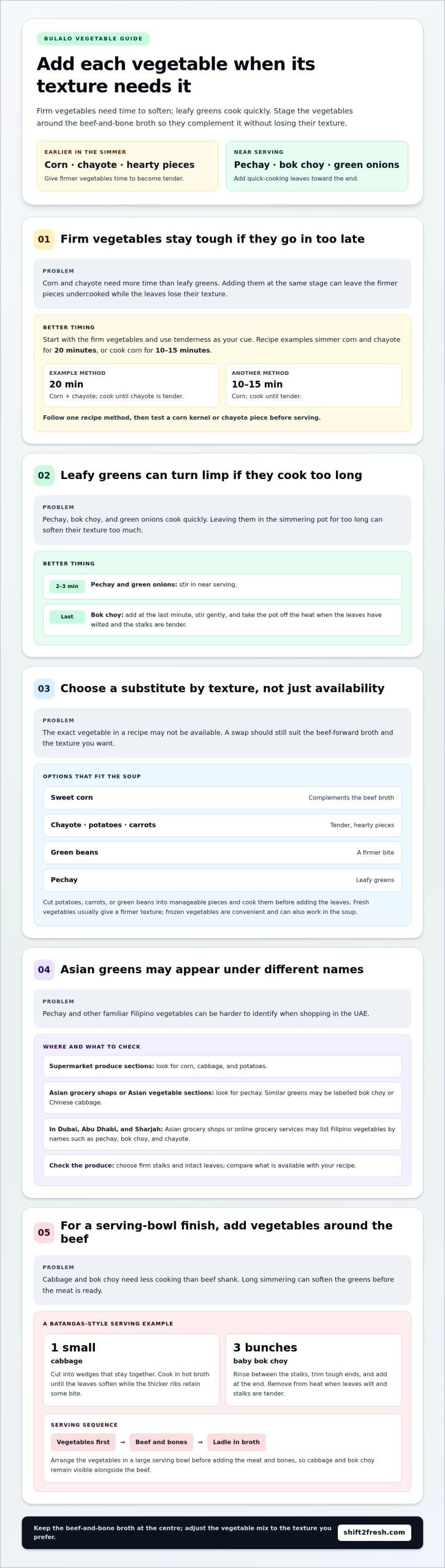
- Add firm vegetables earlier so they have time to soften; stir in leafy greens near the end to keep their texture.
- Build the soup around beef shank and bones, then season the broth to suit your taste.
- Arrange cabbage and bok choy for serving, and add bok choy at the last minute.
- Adjust the vegetable mix to your preference while keeping the soup’s beef-forward character.
Alternative bulalo vegetables
Fresh vegetables usually give bulalo a firmer texture, while frozen vegetables are convenient and can work in the soup. For vegetables for bulalo in the UAE, choose based on the texture and ingredients your recipe needs.
- Choose alternatives by texture and flavour. Sweet corn complements the beef broth, while chayote, potatoes, and carrots add tender, hearty pieces. Green beans provide a firmer bite, and pechay adds leafy greens. These options let you adapt bulalo to the produce available without changing its beef-and-bone base. Start with the vegetables familiar to your recipe, then substitute to suit what you find in the UAE.
- Look for corn, cabbage, and potatoes in supermarket produce sections. For pechay, try Asian grocery shops or the Asian vegetable section of a supermarket. Similar greens may be labelled bok choy or Chinese cabbage, so check the name and appearance before buying. Choose firm stalks and intact leaves.
- In Dubai, Abu Dhabi, and Sharjah, try Asian grocery shops or online grocery services for Filipino vegetables. Search by names such as pechay, bok choy, and chayote. For vegetables for bulalo in the UAE, compare the available options with your recipe and choose suitable alternatives if needed. In Sharjah, Asian-focused grocery shops are another place to look for Filipino cooking ingredients.
- Add firmer vegetables according to their cooking needs. One recipe simmers corn and chayote for 20 minutes, or until the chayote is tender. Another cooks corn for 10 to 15 minutes, until tender. Follow one method and use tenderness as your cue. Test a corn kernel or chayote piece before serving.
- Keep leafy greens for the final stage. Pechay and green onions cook for about 2 to 3 minutes, so add them near serving. If using potatoes, carrots, or green beans, cut them into manageable pieces and cook them before the leaves. When shopping for vegetables for bulalo in the UAE, choose a mix that matches your preferred texture, then add each vegetable in stages.
Beef shank and bone soup ingredients
Build bulalo around beef shank, marrow bones, aromatics, and seasonings. Ingredient quantities vary by recipe, so use one recipe as your starting point rather than combining amounts from different versions.
- Choose the beef base first. One Batangas-style recipe uses 3 to 4 lbs. of beef shank with extra bones. Another calls for 3 pounds of bone-in beef shanks, while a smaller version uses 1 pound of beef shank and 2 beef marrow bones. Choose shank with bone for the soup’s hearty centre; marrow bones add another rich element to the broth.
- Prepare the aromatics and seasoning as a matched set. One Batangas recipe uses 4 medium red onions, 1 tablespoon of whole peppercorn, and 1 ½ tablespoons of rock salt or coarse sea salt. Fish sauce is a seasoning, but the amount varies by recipe. A separate recipe uses 1 large onion and 2 tablespoons of fish sauce, so keep its quantities together instead of mixing them.
- Clean the meat using one recipe’s method. Bring the beef and bones to a boil for about 10 minutes, then discard that water and start the soup with fresh water. Another method simmers the shank and bones on low to medium heat for 1 hour before skimming scum and oil. Follow one approach from start to finish.
- Give the shank enough time to become tender. One method simmers beef shanks for about 1 ½ to 2 hours, until fork-tender. Another recipe adds onions, peppercorn, salt, and fish sauce before boiling the bulalo for 3 hours. For a pressure-cooker version, one recipe cooks the beef and bones for 1 ½ hours; without a pressure cooker, another simmers until fork-tender for 4-5 hours.
- Add vegetables after the broth and beef are underway. One bulalo ingredient list includes 2 ears of corn, 1 bunch of pechay, 2 green onions, and 1 peeled and cubed chayote. Treat these as additions to the shank-and-bone base, not replacements for its aromatics. Keep the vegetable quantities with their recipe, then adjust the sequence to suit each vegetable’s cooking time.
Adding cabbage and bok choy for serving
For a serving-style finish, prepare the cabbage and bok choy separately from the long-simmering beef. Use a Batangas-style combination of 1 small cabbage and 3 bunches of baby bok choy, then assemble the vegetables and meat in a large bowl.
- Choose cabbage with compact leaves and a firm head. Remove any damaged outer leaves, then cut the cabbage into wedges that stay together during serving. A Batangas bulalo recipe uses 1 small cabbage, which gives the broth a mild, sweet vegetable note. Keep the pieces large enough to lift from the serving bowl without breaking apart.
- Prepare the baby bok choy by separating the leaves and rinsing away grit between the stalks. Trim the tough ends, but leave the tender stalks attached to each leaf. The Batangas recipe includes 3 bunches of baby bok choy. Keep the leaves whole or split larger pieces lengthwise, so they sit neatly beside cabbage in the serving bowl.
- Add cabbage to hot bulalo broth when you want its leaves to soften while the thicker ribs retain some bite. Unlike beef shank, cabbage needs little time in the pot. Check a rib with a fork and remove the cabbage when it reaches your preferred tenderness.
- Add baby bok choy at the end rather than leaving it in the simmering pot. Its leaves and stalks cook quickly in hot broth, and prolonged cooking can make them limp. Stir it gently through the soup, then take the pot off the heat once the leaves have wilted and the stalks are tender.
- Arrange the cooked vegetables in a large serving bowl before adding the meat and bones. In the Batangas method, the vegetables go in first, followed by the beef and bones. Ladle broth around the ingredients to keep the cabbage and bok choy visible and easy to serve alongside the beef.
- Distribute cabbage and bok choy around the beef shank and bones to balance the serving bowl. If the vegetables sit beneath the meat, lift them carefully with a serving spoon before ladling in the broth. Add the broth gradually to keep the leafy greens arranged, then serve while everything is hot.
Bulalo ingredient list
Build your shopping list around a single recipe and separate vegetables from broth seasonings. This keeps ingredient amounts clear as you prepare bulalo.
Identify Traditional Bulalo Vegetables
Choose your vegetables before shopping and consider the role of each one. Sweet corn, pechay, green beans, potatoes, and carrots appear in bulalo variations; one recipe also includes chayote and green onions. Rather than treating every variation as one fixed list, select the combination that suits your pot and planned serving.
- Use 2 ears of corn for a sweet, substantial addition to the soup.
- Choose 1 bunch of pechay for leafy greens, or use green beans in another variation.
- Include 1 peeled and cubed chayote when following the recipe that names it.
- Potatoes or carrots can stand in as alternatives found in bulalo variations. Treat them as options, not automatic additions to a recipe that already lists corn and chayote.
Check ingredient names before shopping, especially for pechay, which may be sold with other Asian vegetables. Plan your vegetable choices first, then list the remaining ingredients separately. This helps you follow a Filipino-style bulalo recipe without confusing a variation with the core ingredients.
Compile the Bulalo Ingredient List
Write quantities beside each ingredient, then follow one recipe’s amounts consistently. A vegetable-focused list calls for 2 ears of corn, 1 bunch of pechay, 2 green onions, and 1 peeled and cubed chayote. Add these to the beef shank and bone ingredients, rather than substituting vegetables for the soup’s meat base.
- For aromatics, one Batangas recipe uses 4 medium red onions and 1 tablespoon of whole peppercorn.
- For seasoning, that recipe uses 1 ½ tablespoons of rock salt or coarse sea salt, plus 4 to 5 tablespoons of fish sauce.
- Another ingredient list uses 1 large onion and 2 tablespoons of fish sauce. Keep these amounts together as a separate recipe variation.
- For a Batangas-style vegetable serving, add 1 small cabbage and 3 bunches of baby bok choy to the shopping list.
Before cooking, group your ingredients into vegetables, aromatics, seasonings, and beef. Make sure the quantities all come from the same recipe. This helps prevent mixing different amounts of onion or fish sauce, while keeping optional potatoes, carrots, or green beans clearly marked as variations.
What vegetables are traditionally used in Filipino bulalo?
Bulalo vegetables vary by recipe, but corn and leafy greens are familiar additions. Use the steps below to choose a combination and add each ingredient at the right stage.
- Start with sweet corn when you want a vegetable that complements the beef broth. Some bulalo versions include corn, and one ingredient list uses 2 ears. Cut each ear into manageable pieces before adding it to the pot. Corn brings a sweet note and a substantial bite, making it distinct from quick-cooking leafy vegetables.
- Choose pechay for the leafy element in a Filipino-style pot. One recipe lists 1 bunch, while another Batangas-style version includes 3 bunches of baby bok choy. These greens suit the soup’s finish rather than the long simmer. Wash between the leaves and stalks, then add them near serving so they don’t become overly soft.
- Use chayote, green beans, potatoes, or carrots when following a variation. One recipe includes 1 peeled and cubed chayote, while other bulalo variations identify green beans, potatoes, and carrots. These choices change the texture of the bowl: chayote offers tender pieces, while potatoes and carrots make the vegetable portion heartier. Select a few rather than combining every option.
- Match cooking order to the vegetable, not just the recipe name. Corn may simmer for 10 to 15 minutes until tender, while another recipe simmers corn and chayote for 20 minutes or until the chayote softens. Pechay and green onions cook for about 2 to 3 minutes. Add firmer pieces earlier and reserve leafy greens for the end.
- Build a balanced serving bowl with different shapes and textures. For example, pair corn with pechay, or use chayote alongside green beans. Add cabbage and baby bok choy if following the Batangas-style serving, which includes 1 small cabbage and 3 bunches of baby bok choy. Keep the beef broth central, and let vegetables complement its flavour.
- Choose produce by the recipe you plan to cook in the UAE. Pechay, bok choy, chayote, corn, and cabbage each serve a different purpose, so list them by name before shopping. If you’re planning a Filipino-style pot, find ingredients for your bulalo and select vegetables that match your preferred combination.
Shift 2 Fresh: Seasonal Filipino Fruits
Shift 2 Fresh is a useful next step when you’re planning bulalo and want Filipino and Asian ingredients in the UAE. Its Asian Vegetables offering can help you look for produce suited to Filipino cooking, while Filipino Pantry Items complement a home-cooked meal. Seasonal Filipino Fruits offer another option for rounding out your grocery choices.
Use Mobile App Ordering to browse the grocery selection as you plan your ingredients. Choose vegetables that match your recipe, then prepare them according to their cooking times so leafy greens don’t simmer as long as firm vegetables. For Filipino cooking ingredients and produce, visit shift2fresh.com or contact Shift 2 Fresh.
Make Your Next Bulalo Pot Your Own
Use your next pot of bulalo to find the vegetable combination your household enjoys most. Note which ingredients you used and how you prepared them. This makes it easier to adjust your shopping list next time, whether you prefer a classic mix or want to try a different vegetable with the beef.
For cooks searching for vegetables for bulalo in the UAE, ingredient planning can also be a chance to explore more Filipino flavours. Shift 2 Fresh offers Asian Vegetables, Filipino Pantry Items, and Seasonal Filipino Fruits, giving you options to consider for bulalo and other home-cooked meals.
Choose the ingredients that fit your recipe, then enjoy shaping a bowl that feels right for your table. Contact Shift 2 Fresh today to explore its Filipino and Asian grocery offerings. Your next comforting pot of bulalo can start with a thoughtful choice at the grocery stage.
Frequently Asked Questions
What are pechay substitutes available in UAE grocery stores?
Bok choy is the closest substitute because it has tender leaves and crisp stalks suited to soup. Cabbage works when you want leaves that hold their shape, while green beans provide a firmer, non-leafy option. In UAE grocery shops, look for bok choy in Asian vegetable sections and compare the stalks and leaves. Choose fresh, intact greens, then adjust the cut to suit your serving bowl.
How do you prepare and add vegetables to bulalo?
Wash vegetables thoroughly, remove damaged parts, and cut them into easy-to-serve pieces. Keep firm vegetables separate from leafy greens so you can add them at different stages. Prepare corn and chayote first, for example, then set pechay or bok choy aside until the broth is nearly ready. Taste a firm piece before serving, and remove the pot from the heat once the greens are just tender.
Which UAE supermarkets sell corn, cabbage, potatoes, and pechay for bulalo?
Find corn, cabbage, and potatoes in supermarket produce sections. For pechay, try Asian grocery shops or the Asian vegetable section of a supermarket.
What vegetables can replace Filipino cabbage in bulalo?
Pechay, green beans, potatoes, carrots, corn, and chayote all appear in bulalo variations. Choose a mix that suits your preferred texture.
0 comments