

Imagine finally tracking down a source for authentic calamansi or sun-ripened durian, only to have the box arrive at your doorstep in Abu Dhabi bruised and uncomfortably warm. It’s a disheartening moment that many expats face when trying to find reliable imported Asian produce delivery UAE options. You aren’t just buying groceries; you’re looking for a taste of home, yet the uncertainty of pesticide residues and last mile temperature control can make every order feel like a risky gamble.
We agree that your family’s health and the quality of your traditional meals shouldn’t be left to chance. That’s why understanding the UAE’s 2026 Unified National Food Safety System and the ZAD registration process is essential for every shopper. In this guide, you’ll learn the exact safety standards that govern fresh produce delivery and how to identify providers that truly master the cold chain. We’ll provide a practical quality checklist and explain the latest transparency regulations, giving you the confidence to fill your kitchen with the best Filipino and Asian specialty items available in the Emirates today.
Key Takeaways
- Understand how the 2026 Unified National Food Safety System and ZAD registration protect your health by ensuring every imported item is tracked and verified.
- Learn why maintaining a strict cold chain is the most critical factor for a successful imported Asian produce delivery UAE and how to spot temperature failures before you accept a package.
- Discover why modern e-commerce platforms often offer superior traceability and hygiene compared to traditional bulk market bins for delicate seasonal fruits.
- Use our professional checklist to verify a provider’s municipality permits and trade license transparency directly through their mobile app.
- Find out how 45 years of industry expertise helps bridge the gap between farms in the Philippines and your kitchen in the Emirates without sacrificing quality.
The UAE Regulatory Landscape for Fresh Food Delivery
The Ministry of Climate Change and Environment (MOCCAE) creates the federal blueprint for food safety, ensuring that every piece of fruit or vegetable entering the country meets rigorous health criteria. While the government invests heavily in Agriculture in the United Arab Emirates to boost local supply, the demand for high quality imports remains a cornerstone of the market. This is where the National Food Security Strategy 2051 comes into play. It doesn’t just focus on quantity; it mandates a level of quality that ensures consumers receive “Grade A” products. For you, this means produce must be free from significant blemishes, uniform in size, and harvested at peak maturity to survive the journey to your door.
National Food Safety Law Basics
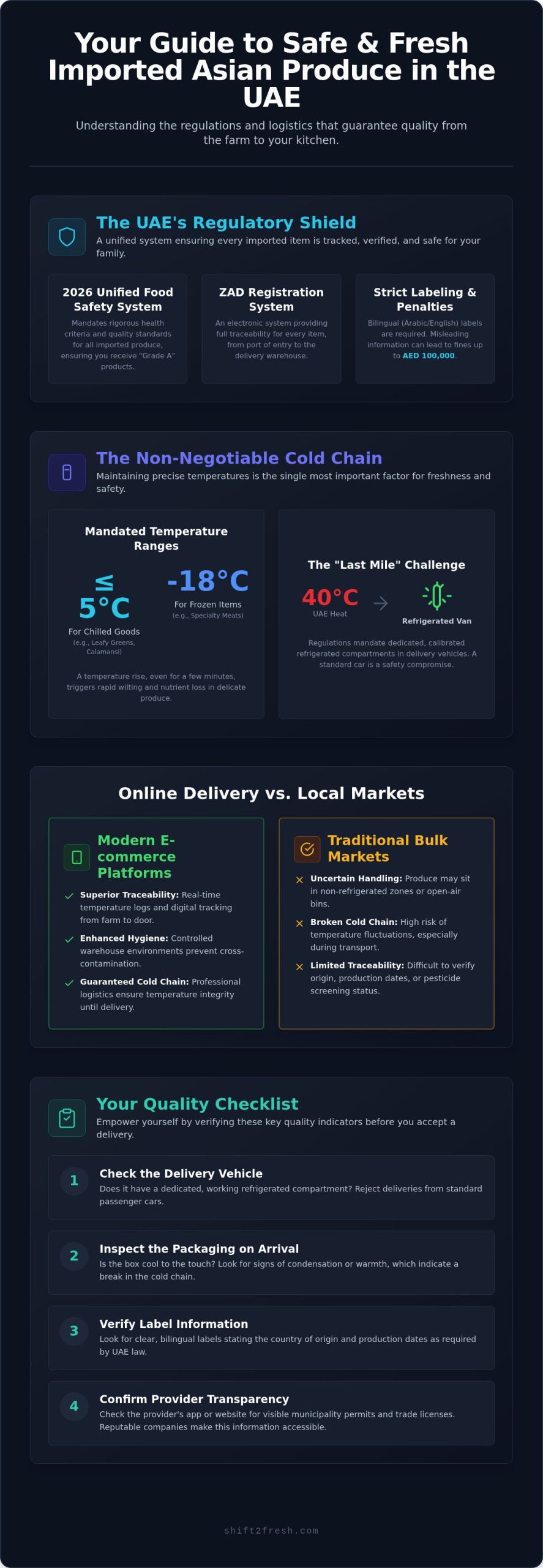
The UAE’s unified food safety system, strengthened in 2026, requires all items to be registered via the ZAD electronic system. This level of traceability is vital for any reliable imported Asian produce delivery UAE provider. Labels must be bilingual in Arabic and English, clearly stating the country of origin and production dates. If a label is misleading or non-compliant, businesses can face fines up to AED 100,000. Pesticide residue limits are strictly monitored at ports of entry, meaning the okra or bitter melon in your basket has already passed federal health screenings before it reaches a delivery warehouse. You always have the right to report non-compliance to the authorities if the quality doesn’t match the legal description on the packaging.
Regional Logistics: Dubai vs. Sharjah Standards
While federal laws set the stage, local municipalities handle the last-mile inspections that affect your daily orders. In Dubai, the Department of Economy and Tourism (DET) issues guidelines such as Ministerial Resolution No. (32) of 2026, focusing on platform transparency and driver conduct. Sharjah Municipality, however, is particularly known for its strict enforcement in Sharjah Industrial areas. Delivery vehicles there must meet specific hygiene certifications and ventilation standards that are checked frequently by local inspectors.
During the current 2026 Smart City logistics phase, these municipalities coordinate via digital platforms to track delivery vans in real time. A van carrying an imported Asian produce delivery UAE in Sharjah must maintain the same strict temperature controls as one in Dubai Marina. The difference often lies in the frequency of spot checks. Sharjah inspectors frequently audit specialized logistics hubs to ensure that seasonal items, like calamansi or durian, aren’t sitting in non-refrigerated zones during the loading process. This regional oversight ensures that your specialty greens don’t wilt in the heat while the driver navigates traffic between emirates.
Cold Chain Logistics: The Non-Negotiable Standard for Imported Produce
When you order specialty greens from Southeast Asia, the journey is a race against the desert heat. A “break in the chain” occurs whenever the temperature rises above the required 5°C for chilled goods, even for a few minutes. This fluctuation triggers rapid wilting and nutrient loss in delicate Asian vegetables. According to reports on the UAE Cold Chain Logistics Market, the sector is rapidly evolving to prevent these gaps through advanced 3PL providers. By 2026, top-tier apps for imported Asian produce delivery UAE provide real-time temperature logs. You can now see exactly how cold your calamansi remained during every minute of transit.
The “last mile” is the most dangerous stage of this journey. When it’s 40°C outside in Dubai or Sharjah, a standard car trunk becomes an oven in seconds. UAE regulations mandate that delivery vehicles have dedicated, calibrated refrigerated compartments. Chilled items must stay at 5°C or below, while frozen items require -18°C. If your delivery arrives in a standard passenger vehicle, the safety standards have been compromised. Professional providers use sensors that alert the dispatch center if a van’s cooling system fails, ensuring that damaged goods never reach your kitchen.
Temperature Requirements for Specialty Produce
Tropical treasures like Lansones and Durian are notoriously finicky. Durian needs a stable, cool environment to prevent over-ripening, while Lansones can brown within hours if humidity isn’t managed. Leafy Asian greens require high humidity to stay crisp, yet too much moisture leads to rot. Shift 2 Fresh addresses this by using air-flown logistics that minimize ground time. This ensures that your imported Asian produce delivery UAE arrives in a “just picked” state. You can explore our current selection of seasonal Filipino fruits to see how we maintain these high standards through specialized handling.
Packaging and Hygiene Standards
In 2026, the UAE has moved toward strict biodegradable and plastic-free packaging mandates. Your produce should arrive in sustainable materials that still provide a thermal barrier against the heat. Hygiene is equally vital during the sorting process. Professional handlers ensure that Filipino pantry items, like sauces or vinegars, are kept in separate zones from fresh fruits to prevent cross-contamination. Every delivery staff member follows sanitation protocols, ensuring that the containers and vehicles are disinfected daily. This level of care is what separates a professional service from a casual marketplace vendor.
Online Delivery vs. Local Markets: Evaluating Quality and Authenticity
Choosing between a physical market and an online provider often comes down to a trade-off between tradition and safety. While local markets offer a sensory experience, they frequently struggle with the stringent traceability standards required for delicate perishables. In a bulk market bin, fruits and vegetables are exposed to fluctuating ambient temperatures and the touch of dozens of shoppers. This physical stress and exposure significantly shorten the shelf life of your greens. A premium imported Asian produce delivery UAE service removes these risks by using trained pickers who handle each item with care in a temperature-controlled facility.
Authenticity is another major hurdle in general UAE supermarkets. You might find “Asian-style” vegetables, but they often lack the specific cultivars and flavor profiles found in the Philippines. By utilizing a specialized grocery store near me, you gain access to direct imports that are vetted for their origin. Beyond quality, consider the hidden costs of physical shopping. Between UAE fuel prices and the time spent in Sharjah or Dubai traffic, the convenience of a door-to-door service often provides better overall value for your household budget.
Direct Import vs. Third-Party Reselling
Buying from a direct importer like Shift 2 Fresh ensures that your produce hasn’t spent unnecessary days sitting in a third-party warehouse. Every middleman in the supply chain adds time and potential for temperature “breaks” that ruin quality. When you source from a direct pipeline, the time from the farm to your table is minimized. It’s vital to ensure the Asian Supermarket Near Me you choose is a licensed importer rather than a reseller, as this guarantees they have full control over the storage conditions from the moment the shipment lands in the UAE.
Traceability and Digital Records
Digital accountability is a game-changer for food safety in the Emirates. When you use an online supermarket dubai platform, every order is linked to a specific batch number. This tracking is essential for managing potential food recalls or quality audits. If a specific shipment of imported Asian produce delivery UAE fails a municipality inspection, digital systems allow providers to identify and notify every affected customer within minutes. This level of transparency provides a safety net that traditional markets simply cannot match, giving you peace of mind with every meal you prepare.
Consumer Checklist: Verifying Your imported Asian produce delivery UAE
When the delivery van pulls up to your villa or apartment, your role as a vigilant consumer begins. Don’t simply accept the box and head inside. A professional imported Asian produce delivery UAE service should be transparent about its credentials. Start by checking the mobile app or the physical invoice for a valid UAE trade license number and municipality permit details. Under the 2026 updates to Circular No. 2, delivery platforms must provide clear business transparency. If you can’t find a physical address or contact number for the provider within the Emirates, consider it a major warning sign.
Take a moment to look at the delivery vehicle itself. It must be a dedicated refrigerated van with a visible municipality permit sticker. If your groceries arrive in a standard passenger car or a non-refrigerated bike box, the cold chain has been compromised. Next, evaluate the internal packaging. Delicate items like calamansi or small chilies should be protected in sturdy, breathable containers rather than crushed at the bottom of a heavy bag. Every item must have a clear label stating its country of origin, ensuring you aren’t receiving generic substitutes for authentic Philippine produce.
Red Flags to Watch For
The most immediate red flag is the temperature of the goods upon arrival. If your leafy greens or fruits arrive at room temperature during a 40°C UAE summer day, the provider has failed to maintain the required 5°C environment. You should also be wary of vague product descriptions. A reputable provider will never just list “Asian produce”; they will specify the variety and origin. Lack of batch tracking or digital receipts is another sign that the company lacks the infrastructure to handle food safety recalls effectively. If you notice these issues, you can browse our verified catalog of Asian vegetables to see how professional standards should look.
How to Store Your Delivery for Maximum Longevity
Once your order is inside, follow the “First In, First Out” rule to minimize waste. This is especially vital for Seasonal Filipino Fruits, which often have shorter peak windows than local produce. To keep your kitchen organized and your food fresh, follow these storage basics:
- Manage Ethylene Gas: Keep ripening fruits like bananas or mangoes away from leafy greens. These fruits release ethylene gas, which causes vegetables to wilt and yellow much faster.
- Ventilation: Don’t pack your refrigerator too tightly. Cold air needs to circulate around the produce to maintain a consistent temperature.
- Cleaning Protocols: Wait to wash your vegetables until right before you use them. Excess moisture in the fridge can lead to mold growth and rot.
By following this checklist and storage guide, you ensure that the high standards maintained during transit continue right up until your meal is served.
Shift 2 Fresh: Exceeding UAE Standards for Filipino Specialty Produce
Shift 2 Fresh isn’t just a delivery service; it’s a logistics operation built on 45 years of food industry experience. This deep history allows us to navigate the complex 2026 UAE import landscape with precision. We’ve developed a “Farm-to-Sharjah” pipeline that cuts out unnecessary storage time, ensuring that our imported Asian produce delivery UAE remains the freshest in the market. Our team understands that moving delicate items across continents requires more than just a refrigerated van. It requires specialized knowledge of how each fruit and vegetable behaves under pressure during the long journey from the Philippines.
Our trained pickers are the backbone of our quality control. They understand the specific fragility of items like Ube and Lansones, which can be ruined by even minor mishandling. While general supermarkets might treat all produce the same, we recognize that specialty items require a tailored approach. This expertise is what allows us to bridge the gap between global sourcing and your local kitchen table without sacrificing the “just picked” quality you expect.
Specialized Handling for Filipino Favorites
Handling items like Durian requires a specific set of protocols to manage both its delicate skin and its powerful aroma. We use airtight, specialized containers during transit to ensure the scent doesn’t permeate other items in your order. We also take great care when you order Filipino Pantry Items alongside your fresh goods. Heavier jars of bagoong or bottles of vinegar are packed in separate compartments to prevent them from crushing your leafy greens or soft fruits. If your produce arrives in anything less than perfect condition, our quality guarantee ensures that we address the issue immediately. We believe that a “taste of home” should never come with the disappointment of bruised fruit.
Convenience Meets Compliance
Transparency is the foundation of our mobile app ordering system. In full alignment with the 2026 Dubai DET circulars, we provide real-time tracking and clear origin labeling for every item in your cart. You won’t find hidden fees or vague descriptions here; just honest pricing and authentic produce. For families stocking up on their weekly essentials, we offer free shipping on orders over AED 500. This premium service ensures that your large family needs are met without the extra cost of logistics. Don’t settle for bruised, room-temperature substitutes when you can have professional care. Experience the highest standards of Filipino produce delivery today and see the difference that 45 years of expertise makes in every bite.
Secure Your Taste of Home with Confidence
Navigating the 2026 food safety landscape in the Emirates doesn’t have to be overwhelming. You now have the essential tools to verify municipality permits, inspect delivery vehicles, and understand the critical importance of an unbroken cold chain. By prioritizing providers who offer full transparency and digital traceability, you ensure that every seasonal fruit and vegetable in your kitchen meets the highest federal standards for quality and health.
Shift 2 Fresh stands at the intersection of this rigorous compliance and authentic flavor. As direct importers with 45 years of industry expertise, we leverage trained fresh produce specialists to manage the “last mile” with absolute care. Don’t settle for bruised or improperly stored items when you can have the best imported Asian produce delivery UAE has to offer delivered straight to your door. Our commitment to excellence means you can focus on the joy of cooking traditional meals for your family.
Shop Authentic, High-Standard Filipino Produce Now
Your next family gathering deserves the vibrant colors and rich flavors of home, handled with the professional care you deserve.
Frequently Asked Questions
What are the mandatory food safety labels for fresh produce in the UAE?
Mandatory labels must include bilingual text in both Arabic and English. You should look for the product name, net weight, country of origin, and clear production and expiry dates on every package. Additionally, any potential allergens must be highlighted to meet federal safety standards. These requirements ensure that your imported Asian produce delivery UAE remains transparent and traceable from the moment it enters the country until it reaches your kitchen.
How does the UAE government ensure imported fruits are free from pesticides?
The Ministry of Climate Change and Environment (MOCCAE) enforces strict pesticide residue limits at all ports of entry. Every shipment undergoes inspection and testing against federal health standards before it’s cleared for local sale. All products must also be registered through the ZAD electronic system, which tracks food safety data. This rigorous oversight prevents non-compliant goods from entering the market, ensuring that the specialty fruits you order are safe for your family.
Can I complain to the Dubai Municipality if my grocery delivery is not fresh?
You can file a formal complaint with Dubai Municipality if your grocery delivery fails to meet health or freshness standards. Use the Dubai 24/7 mobile app or call their toll-free hotline at 800900 to report issues like spoiled produce or temperature violations. Keeping your digital receipt and photos of the damaged goods is essential. This documentation allows the inspection team to verify your claim and take appropriate action against the non-compliant provider.
What is the “Cold Chain” and why is it vital for UAE food delivery?
The cold chain is a temperature-controlled supply chain that remains uninterrupted from the farm to your doorstep. For fresh produce in the Emirates, this requires maintaining a constant temperature of 5°C or below. It’s vital because even brief exposure to the 40°C summer heat can cause rapid bacterial growth and spoilage. A professional imported Asian produce delivery UAE service uses specialized refrigerated vans to ensure this chain stays intact during the critical last mile.
Are there specific delivery standards for Sharjah vs. Dubai?
Both emirates follow federal food safety laws, but local municipalities handle specific enforcement differently. Sharjah Municipality is known for its rigorous inspections within industrial zones, particularly regarding the hygiene of logistics hubs. Dubai focuses heavily on digital transparency and platform conduct through DET circulars. Regardless of the emirate, delivery vehicles must always be municipality-approved and refrigerated. Shift 2 Fresh operates from Sharjah, ensuring all regional and federal standards are met before shipping across the country.
How should I report a delivery platform that uses non-refrigerated vehicles?
If a delivery arrives in a standard passenger car or a non-refrigerated bike box, you should report the platform immediately to the relevant local municipality. In Dubai, use the Consumer Rights section of the DET website or the Dubai 24/7 app. In Sharjah, contact the Sharjah Municipality hotline directly. Using non-specialized vehicles for perishables violates UAE food safety laws and poses a significant health risk to consumers, especially during the high-temperature summer months.
What makes Filipino produce delivery unique in terms of standards?
Filipino produce often requires specialized handling due to the extreme fragility of items like Lansones or the strong aroma of Durian. Unlike standard vegetables, these specialty goods need precise humidity and temperature settings to survive the long flight from the Philippines. Shift 2 Fresh utilizes 45 years of industry expertise to manage these unique requirements. Our trained staff ensures that delicate items are packed separately from heavy pantry staples to prevent any crushing during transit.
How can I verify if an online grocery store is licensed in the UAE?
You can verify a store’s legitimacy by checking for a valid UAE trade license number and a physical business address on their app or website. Professional platforms also display their municipality permits for food handling and delivery. Avoid ordering from social media accounts that lack a registered trade license or a transparent contact number. Legitimate providers like Shift 2 Fresh are fully licensed and operate from dedicated facilities, providing you with digital receipts for every transaction.
0 comments