

Why do we continue to pay premium prices for flavorless, imported produce when a local Abu Dhabi greenhouse just harvested the most vibrant peppers of the season? Most residents in the Emirates feel the frustration of watching their grocery budget disappear on vegetables that wilt within 48 hours of purchase. This seasonal eating guide uae is your essential roadmap to 2026, helping you sync your kitchen with the desert’s unique harvest and the Philippines’ tropical peaks for maximum nutrition. With food imports accounting for roughly 85% of the UAE’s food supply according to recent trade data, finding local alternatives is more important than ever.
You’ll discover how to stop overpaying for “evergreen” supermarket items that have traveled thousands of miles. We provide a clear calendar for when to buy local cucumbers and kale, alongside the best months for imported mangoes and pineapples. By the end of this guide, you’ll know exactly how to secure the freshest ingredients while keeping more dirhams in your wallet. It’s time to eat better, support local farmers, and enjoy the true taste of the season.
Key Takeaways
- Master the UAE’s unique “Two-Season” harvest cycle to ensure you are buying local greens in the winter and premium tropical imports when they are at their nutritional peak.
- Use this seasonal eating guide uae to navigate the 2026 harvest, perfectly timing your kitchen staples between local desert crops and vibrant imports from the Philippines.
- Discover why online supermarkets often provide fresher specialty produce than physical stores and how to avoid common storage mistakes that ruin delicate tropical fruits.
- Learn to identify the best Filipino mango varieties during the summer surge (May–September) to maintain a high-nutrient diet when local production slows down.
- Leverage real-time tracking through the Shift 2 Fresh app to stay updated on the arrival of the freshest seasonal shipments directly to your doorstep in the Emirates.
What Does ‘Seasonal Eating’ Mean in the UAE Landscape?
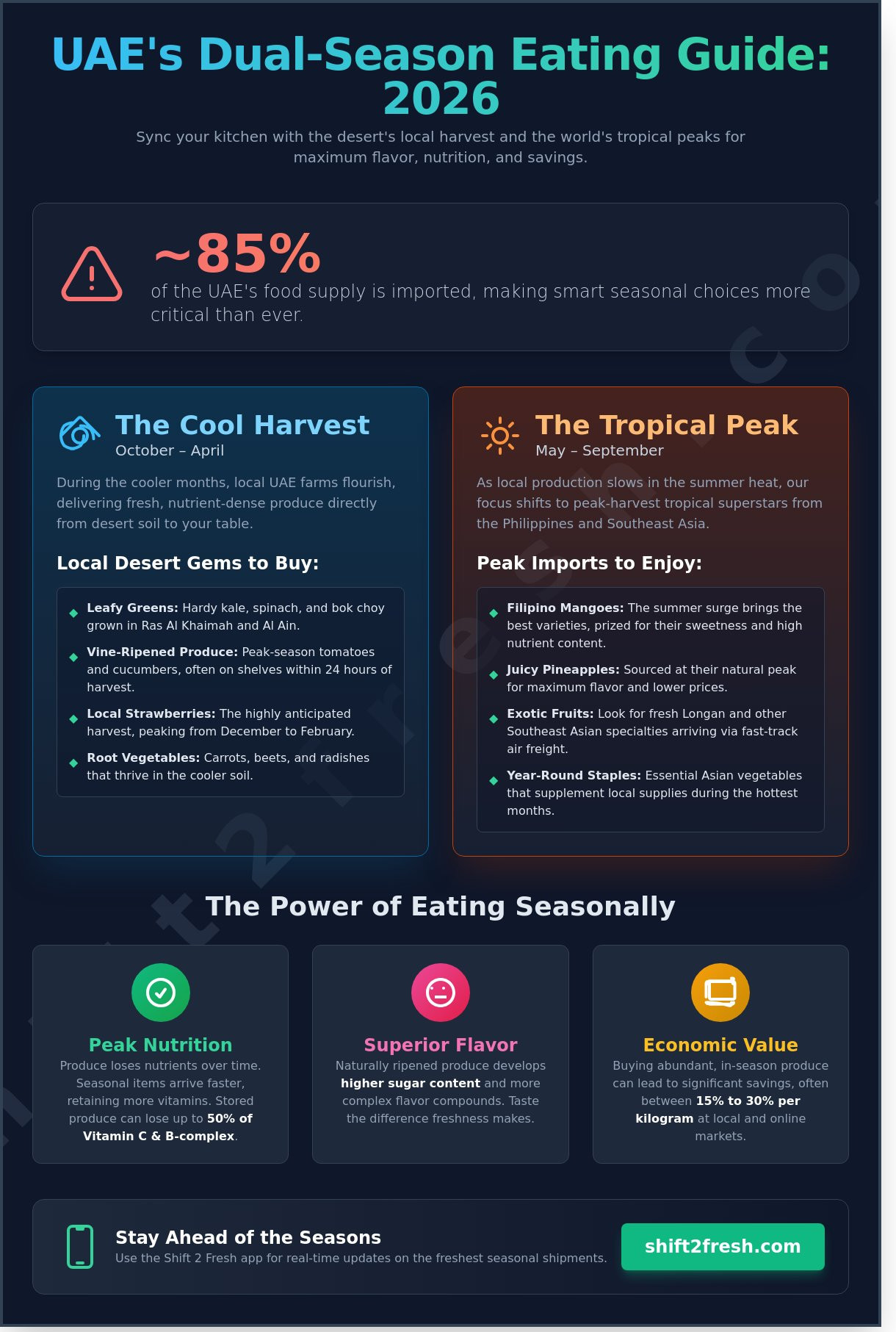
Seasonal eating in the Emirates isn’t just about following the harvest of a single climate. It’s a sophisticated strategy that balances desert-grown produce with the natural cycles of our global trade partners. In a hyper-import economy where the UAE imports approximately 85% to 90% of its food, this seasonal eating guide uae helps you navigate the two distinct phases of our market. We don’t just have one growing season; we have a dual-cycle reality that dictates what lands on your plate in 2026.
The first phase is the Cool Harvest, spanning from October to April. During these months, the local agricultural sector produces everything from kale to strawberries. The second phase is the Tropical Import Peak, running from May to September. As temperatures rise above 45°C locally, our focus shifts to the peak harvests of the Philippines, India, and Thailand. Understanding these shifts reduces your carbon footprint and ensures you aren’t paying a premium for produce that was picked weeks too early. By aligning your kitchen with these cycles, you significantly reduce food miles and support more sustainable supply chains.
Local vs. Imported: Finding the Balance
Finding the right balance requires understanding why some items are year-round staples while others are fleeting treats. Dates remain the cornerstone of Agriculture in the UAE, with over 40 million palm trees providing a permanent local source. However, items like mangoes or pineapples rely entirely on global cycles. The UAE’s 2051 National Food Security Strategy has accelerated local hydroponics, but tropical imports remain vital for dietary diversity during the summer months. Peak-import is the window where tropical fruit quality is highest and prices are lowest.
The Nutritional Power of Freshness
Freshness is a biological metric, not just a marketing term. When produce sits in cold storage for months, vitamin C and B-complex levels can drop by as much as 50% depending on the variety. Seasonal items reach the UAE via fast-track air freight or short-haul sea routes, meaning they spend less time degrading in dark containers. Eating with the seasons also supports a diverse gut microbiome. By rotating your diet between winter leafy greens and summer tropical fruits, you introduce a wider range of polyphenols and fibers to your system.
- Higher Nutrient Density: Local winter greens are often on shelves within 24 hours of harvest.
- Better Flavor Profiles: Produce picked at its natural peak contains higher natural sugar content.
- Economic Value: Buying at the peak of a season often results in savings of 15% to 30% per kilogram at local markets.
Seasonal produce simply tastes better because it didn’t have to endure early-pick harvesting for long-term storage. When fruit stays on the vine or tree until it’s ready, the complex flavor compounds have time to fully develop. This is especially true for our 2026 imports from the Philippines, where the volcanic soil creates a mineral profile you won’t find in out-of-season alternatives.
The UAE Winter Harvest (October–April): Local Bounty Meets Tropical Peaks
October marks a dramatic shift in the UAE food landscape. As temperatures dip below 30 degrees Celsius, the desert soil awakens. This period, stretching until April, represents the peak window for any seasonal eating guide uae enthusiast. Local farms in Ras Al Khaimah and Al Ain begin flooding markets with vibrant produce. You’ll see a unique overlap during these months. While local vine-ripened tomatoes reach their prime in January, they share shelf space with peak-season Filipino citrus imports. It’s a rare window where desert harvests and tropical peaks align perfectly.
Winter superstars include hardy kale, which thrives in the cooler nights, and the highly anticipated local strawberry harvest that usually peaks between December and February. You’ll also find fresh Longan arriving from Southeast Asia, offering a sweet, floral contrast to the earthy local greens. This is the best time to explore Essential Asian Vegetables like bok choy and kailan, which are now grown extensively in regional soil rather than being flown in from thousands of miles away.
Local Desert Gems: What to Buy from UAE Farms
Cruciferous vegetables like broccoli and cauliflower dominate the winter months, offering a crunch and sweetness that summer varieties lack. Local peppers, ranging from sweet bells to fiery chilies, hit their peak in March. To find truly local produce, look for the “Product of UAE” logo in Sharjah’s Central Market or Dubai’s Al Aweer. Many shoppers now prioritize hydroponic greens for their salads. With over 1,000 hydroponic farms registered in the country as of 2025, you can find pesticide-free lettuce and herbs throughout the cool season. These farms use roughly 90 percent less water than traditional methods, making them a sustainable choice for your seasonal eating guide uae shopping list.
The Filipino Winter Connection: Calamansi and Ube
Calamansi serves as a vital immunity booster during the UAE’s shorter winter days. These small, potent citrus fruits arrive in high volumes from the Philippines during the cooler months. Their high Vitamin C content helps residents stay healthy when the evening air turns chilly. Similarly, the Ube (purple yam) harvest cycle in the Philippines aligns perfectly with the UAE winter. Authentic tubers are most abundant in local specialty groceries from November through January. You can learn how to use these in hearty stews or desserts by checking out Essential Filipino Ingredients for your winter pantry. If you want to simplify your healthy habits this season, you can browse our latest farm-to-table arrivals to see what’s currently at its peak.
Navigating the UAE Summer (May–September): The Rise of Tropical Superstars
When the UAE mercury hits 45°C between June and August, local agricultural output for leafy greens and tomatoes drops by nearly 80 percent. This creates a gap that tropical imports fill perfectly. This period is the heart of any seasonal eating guide uae because it highlights how global supply chains support local wellness. Tropical fruits thrive in high humidity and heat, making them the ideal biological match for the Emirates’ harshest months. While desert farms go into a maintenance phase, the orchards of Southeast Asia reach their peak productivity.
Staying hydrated in the UAE summer requires more than just drinking water. Filipino fruits like the juicy Rambutan or the refreshing Lansones provide structured water and essential fiber. These fruits help the body retain fluids longer than plain water alone. A single serving of Rambutan contains approximately 82 percent water. It’s a functional snack for residents commuting between air-conditioned zones in Dubai or Sharjah. Choosing these items during their natural harvest window ensures you get the highest nutrient density when your body is under heat stress.
The Philippine Mango Harvest: A Summer Staple
The Carabao mango is the undisputed star of the Philippine summer. It’s famous for a thin seed and high sugar content, often reaching a Brix level of 18 or higher. You’ll find different varieties peaking at specific times, which we detail in our Seasonal Filipino Fruits guide. Varieties from Guimaras and Zambales are particularly prized for their smooth, fiber-free flesh. These mangoes don’t just offer sweetness; they’re packed with Vitamin C to support your immune system during the transition into peak summer.
To ripen these at home in the UAE, keep them in a brown paper bag on your kitchen counter. Avoid the refrigerator until they’re fully yellow and yield to gentle pressure. The cold air from AC vents can stunt the ripening process and turn the flesh rubbery. Once they’re ripe, they’ll stay fresh in the fridge for up to five days. It’s a simple way to enjoy world-class produce at its best.
Exotic Summer Arrivals: Durian, Lansones, and Rambutan
Durian and Lansones arrive in the UAE with a short, intense harvest window that usually peaks in August. Durian is a nutritional powerhouse. It offers high levels of potassium and healthy fats that help maintain electrolyte balance during sweaty 42°C days. Many athletes in the region use it as a pre-workout energy source because of its dense caloric profile. Lansones provide a refreshing, grapefruit-like sweetness that aids digestion and provides a quick glucose boost without the heavy crash.
Shift 2 Fresh manages the logistics by using temperature-controlled air freight directly to Sharjah. This ensures these delicate fruits don’t sit in port heat. It’s a critical part of the seasonal eating guide uae because delicate skins on Rambutan and Lansones can dry out within hours if exposed to the desert wind. By controlling the cold chain from the farm to your doorstep, the quality remains consistent with what you’d find in a Manila market.
How to Source and Store Seasonal Produce in the Emirates
Mastering a seasonal eating guide uae requires more than just knowing what is in stock. It demands a shift in how you handle produce. The biggest mistake residents make is treating delicate tropical imports like hardy, wax-coated supermarket apples. While a commercial apple might survive three weeks in a fruit bowl, a tree-ripened Philippine mango or a Thai mangosteen has a shelf life measured in days. These fruits are living organisms with high respiration rates. When they move from 22°C air-conditioned apartments to the humid outdoors during transport, they can deteriorate rapidly if not handled with precision.
Data from regional logistics reports in 2025 shows that online supermarkets often provide fresher specialty items than physical retail shelves. In a traditional store, produce might sit under fluorescent lights for 48 to 72 hours before you buy it. Specialized Gourmet Food Delivery in Dubai bypasses this retail lag. By using temperature-controlled “dark stores” and direct-to-door logistics, the time between the farm and your kitchen is reduced by up to 40%. To ensure you aren’t buying last season’s cold-stored stock, check the “Country of Origin” and “Pack Date” labels. If a tropical fruit feels unusually heavy and shows moisture beads on the skin while on a room-temperature shelf, it has likely been deep-chilled for weeks. This process kills the flavor profile and results in “mealy” textures once the fruit thaws.
UAE-Specific Storage Hacks for Tropical Fruit
The “Humidity Trap” is a real threat in the Emirates. High AC usage creates a dry internal environment, but the moment you open a balcony door, moisture settles on cold fruit, leading to rapid mold. Keep stone fruits and papayas on the counter until they yield to gentle pressure. Once they’re ripe, move them to the crisper drawer. For sliced fruits like avocado or guava, skip the lemon. Use calamansi juice instead. Its higher acidity levels, with a pH of approximately 2.4, act as a superior natural preservative while adding a citrusy depth that complements Asian varieties.
Finding the Best Asian Supermarket Near You
Physical markets in areas like Al Karama offer a tactile experience, but they often struggle with the “last mile” of freshness during the peak summer heat. Shift 2 Fresh bridges this gap by leveraging Sharjah’s proximity to major shipping ports and airports. This logistics advantage allows for faster transit to Dubai’s residential hubs, ensuring items don’t sit in 40°C loading bays. If you’re tired of wilted bok choy or bruised longan, check out our Asian Supermarket Guide to compare your delivery options and find the freshest stock.
Making the Shift: Your 2026 Year-Round Seasonal Plan
Transitioning to a seasonal lifestyle in the Emirates doesn’t mean you have to limit your plate. The Shift 2 Fresh philosophy centers on bridging the 2,500-mile gap between the fertile orchards of the Philippines and your kitchen in the UAE. By choosing produce at its natural peak, you ensure every dirham spent on your grocery bill supports better flavor and higher nutrient density. This seasonal eating guide uae is designed to help you move away from flavorless, long-storage imports and toward a vibrant, living diet.
Commit to experimenting with at least one new seasonal item every month. In 2026, the logistics of fresh imports are more efficient than ever, allowing highly perishable items like Philippine Guyabano or local UAE organic figs to reach your table within 48 hours of harvest. Use this month-by-month cheat sheet to plan your 2026 meals:
- January to March: Focus on local UAE harvest staples like kale, tomatoes, and peppers. Supplement these with the first arrivals of Philippine Carabao mangoes.
- April to June: This is the peak for Philippine pineapples and papayas. Locally, UAE watermelons and sweet corn are at their best during these warmer months.
- July to September: Embrace the “Exotic Window.” This is the only time to find fresh Lansones, Rambutan, and Mangosteen in peak condition.
- October to December: As the UAE weather cools, local arugula and cucumbers return. Pair them with imported Philippine pomelos and avocados for a balanced winter salad.
Shopping Smarter with the Shift 2 Fresh App
Our mobile app removes the guesswork from your 2026 shopping trips. You can set specific “back in stock” alerts for seasonal favorites that have short harvest windows, such as Lansones or Santol. We leverage 45 years of logistics experience to track shipments from the moment they leave the farm, giving you real-time updates on freshness. Residents in Sharjah and Dubai can also access exclusive app-only bundles that combine local UAE greens with Philippine tropical fruits, delivered directly to your doorstep to maintain the cold chain.
Join the Seasonal Movement
Every choice you make has a ripple effect. By following this seasonal eating guide uae, you directly support sustainable Filipino farming communities that prioritize traditional growing methods over industrial mass production. We encourage you to share your seasonal recipes and storage tips with our growing community of food enthusiasts in the UAE. Your feedback helps us refine our sourcing for the next harvest cycle. Start your seasonal journey with Shift 2 Fresh today and experience the difference that 45 years of agricultural expertise brings to your table.
Master Your 2026 Plate With the Best of the Season
Adopting a smarter approach to your grocery list transforms your health and supports a more sustainable food system. By following this seasonal eating guide uae, you can prioritize local Emirati harvests from October to April and pivot to high-quality tropical imports during the peak summer heat. This strategy ensures you’re eating nutrient-dense food when it’s naturally at its best; not when it’s been sitting in cold storage for months. You’ll save money and discover flavors that mass-produced, out-of-season items simply can’t match.
Shift 2 Fresh leverages 45+ years of food industry expertise to bring these global flavors straight to your doorstep. They specialize in direct imports from the Philippines and South Asia, bridging the gap between tropical farms and UAE kitchens. If you’re ready to taste the difference that direct sourcing makes, it’s time to stock up. You’ll even enjoy free shipping on all orders over AED 500. Shop the freshest seasonal Filipino produce at Shift 2 Fresh today! Your journey toward a more vibrant and flavorful 2026 starts with a single click.
Frequently Asked Questions
What is the best month for Filipino mangoes in the UAE?
The best months for Filipino mangoes in the UAE are April and May. During this peak harvest window, the fruit reaches its highest brix level of sweetness. You’ll find the Carabao variety most abundant in local markets during these 60 days. While available at other times, the quality and price improve significantly when the Philippine harvest is at its height, usually resulting in a better taste profile.
Are local UAE vegetables organic?
Local UAE vegetables aren’t always organic by default. To be classified as organic, a farm must hold a certification from the Ministry of Climate Change and Environment (MOCCAE). Currently, over 35 commercial farms in the UAE are certified organic. Many others use hydroponic systems that minimize pesticides but don’t meet the specific soil based organic criteria required for the official ESMA logo.
How can I tell if a durian is fresh when ordering online?
You can tell a durian is fresh online by checking the product description for tree-ripened or nitrogen-frozen labels. Fresh durian should have a thick, moist stem. If you’re ordering from this seasonal eating guide uae, look for vendors that offer 24 hour delivery from the time of arrival. A high quality frozen durian must arrive in a vacuum sealed pack with no visible ice crystals inside the bag.
Why is seasonal eating cheaper in the UAE?
Seasonal eating is cheaper because it reduces the 15% to 30% markup typically added for long distance air freight and cold chain storage. When produce is in season locally, supply increases which naturally drives down the price in AED. Buying local cucumbers in January can save you 40% compared to buying imported varieties that require expensive logistics to reach Dubai markets during the off-season.
Can I get calamansi year-round in Dubai?
You can get calamansi year-round in Dubai because it’s a staple import from Southeast Asia. While local UAE citrus peaks between December and March, specialized importers ensure a steady supply of these small limes every month. Most stock arrives via air freight twice a week to maintain the 10 day shelf life required for retail. This ensures the fruit stays tart and juicy regardless of the season.
Which UAE months are best for local leafy greens?
The best months for local UAE leafy greens are from November to April. During these six months, the cooler temperatures allow farms in Al Ain and Ras Al Khaimah to produce high quality kale, spinach, and arugula. This period is the core focus of any seasonal eating guide uae because the harvest volume is 70% higher than during the summer months when heat prevents open-field growth.
Does Shift 2 Fresh deliver seasonal produce to all Emirates?
Shift 2 Fresh delivers seasonal produce to all seven Emirates, including Dubai, Abu Dhabi, Sharjah, Ajman, Ras Al Khaimah, Fujairah, and Umm Al Quwain. They operate a fleet of temperature controlled vehicles to ensure items stay below 5 degrees Celsius during transit. Most orders reach customers within 24 to 48 hours of being placed, ensuring the produce doesn’t lose its freshness or nutritional value during the journey.
What are the health benefits of eating seasonally in the desert?
Eating seasonally in the desert ensures you consume produce with 100% of its nutrient profile intact. Local vegetables often reach your table within 24 hours of being picked. This is vital because vitamins like Vitamin C can degrade by 50% within a week of harvest. Fresh, local food supports your hydration levels and provides the specific antioxidants needed to combat high UV exposure during the peak summer months.
0 comments