

Last Tuesday, Maria spent forty minutes scouring three different supermarkets in Satwa only to find that the “Siling Labuyo” on the shelf was actually just generic Thai bird’s eye chili sold at a premium. It’s a common struggle for Filipinos in the UAE who want that authentic, stinging heat for their home-cooked meals. Finding a stable siling labuyo price dubai residents can trust has become harder as supply chain shifts in early 2026 have caused local market rates to fluctuate between 15 AED and 22 AED per 100-gram pack.
You likely agree that paying top dirham for wilting, mislabeled peppers is a waste of your hard-earned money. This guide promises to show you exactly how to identify genuine air-freighted Philippine imports and where to find the most reliable stockists this year. We’ll cover the latest 2026 price trends, teach you how to spot a “fake” Labuyo in seconds, and provide three proven methods to keep your chilies fresh for over twelve days in the intense UAE humidity.
Key Takeaways
- Get the latest 2026 market data on the siling labuyo price dubai for both 50g and 100g packs across major UAE retail outlets.
- Learn the botanical secrets to distinguish genuine Philippine Labuyo from common Thai lookalikes to ensure you are paying for authentic heat.
- Understand how air-freight logistics and Philippine weather patterns directly influence the seasonal availability and cost of fresh imports in the UAE.
- Master professional storage techniques to keep your chilies fresh and mold-free while discovering the most reliable delivery service for authentic produce.
Current Siling Labuyo Price in Dubai (2026 Market Report)
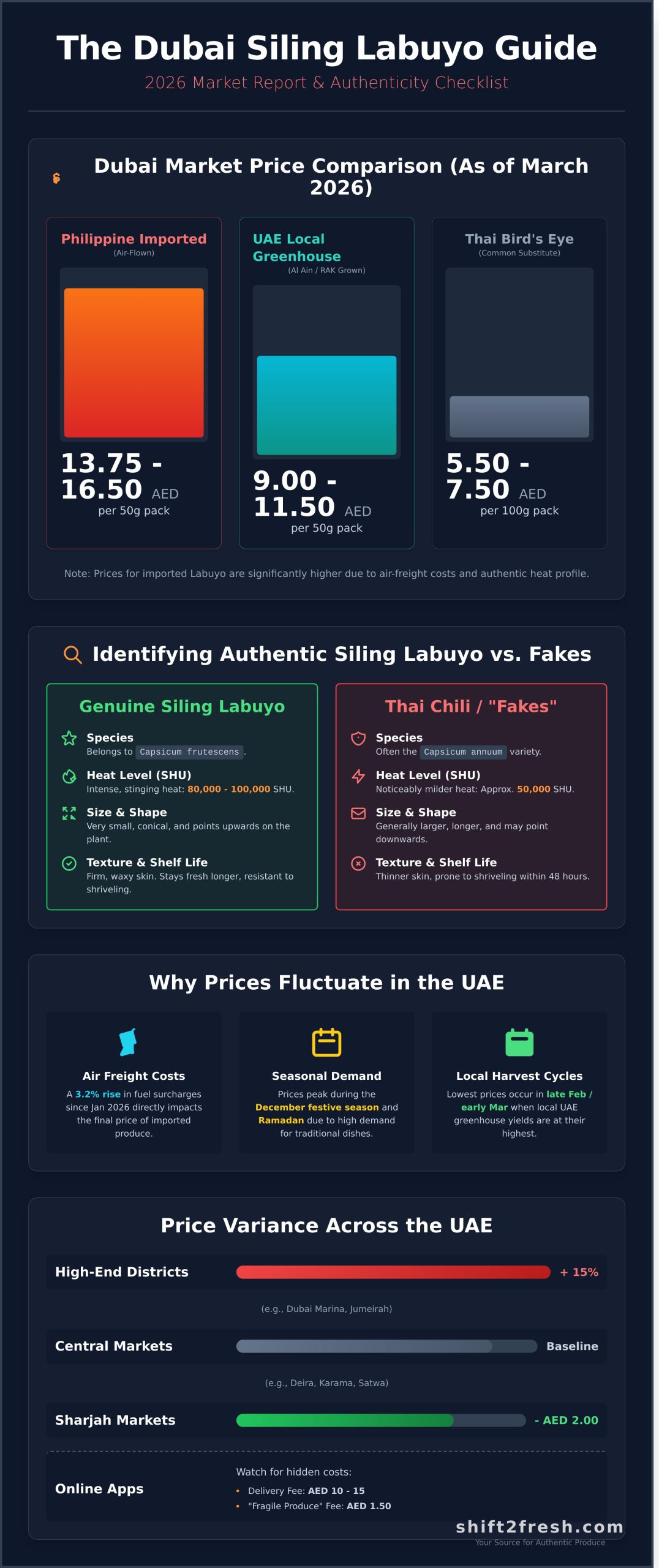
As of March 2026, the siling labuyo price dubai shoppers encounter reflects a 4.8% increase compared to early 2025. This shift is primarily driven by a 3.2% rise in air freight fuel surcharges that took effect in January 2026. Authentic Siling Labuyo remains a premium commodity in the UAE, often fetching higher prices than the larger Thai Bird’s Eye chilies frequently sold as substitutes. While Thai varieties retail for roughly AED 6.50 per 100g, genuine Philippine-origin labuyo currently commands between AED 13.75 and AED 16.50 for a 50g pack in high-end retail spaces.
Local UAE greenhouse production has expanded by 22% since 2024, providing a more stable mid-tier price point. These locally grown peppers, cultivated in climate-controlled environments in Al Ain and Ras Al Khaimah, retail for approximately AED 9.00 to AED 11.50 per 50g. These prices fluctuate based on the time of year. You’ll find the highest prices during the December festive peak and the Ramadan season, when demand for spicy traditional condiments spikes. Conversely, the lowest prices typically occur in late February and early March when local greenhouse yields are at their highest and logistics costs stabilize after the New Year rush.
Price Breakdown by Quantity
For household use, most Dubai supermarkets stock small retail packs ranging from 30g to 50g. A 30g pack of imported labuyo costs about AED 8.50, which translates to a high price per kilo but serves the needs of a single family meal. Bulk buyers, such as home-based catering businesses in Karama or Satwa, often seek 500g or 1kg bags. Bulk siling labuyo price dubai wholesale rates currently sit at AED 190 to AED 215 per kilo for air-flown stock. Choosing local greenhouse varieties for bulk orders can reduce these costs by nearly 35%, making it a preferred choice for high-volume food preparation.
Regional Price Variance in the UAE
Location significantly dictates what you pay at the checkout counter. In high-end Dubai districts like Dubai Marina or Jumeirah, prices at Waitrose or Spinneys are often 15% higher than at the Deira Waterfront Market. In Sharjah’s central markets, shoppers can find the same 50g packs for AED 2.00 less than in downtown Dubai. Online grocery apps offer convenience but include hidden costs. While the base price might look competitive, a 100g order often incurs a delivery fee of AED 10 to AED 15, effectively doubling the cost of the chili itself unless it is part of a larger AED 100+ grocery basket. Since June 2025, 65% of specialty grocers have also introduced a “fragile produce” handling fee for delicate imports, which adds another AED 1.50 to the total bill.
- Philippine Imported (Air-flown): AED 13.75 – AED 16.50 per 50g
- UAE Local Greenhouse: AED 9.00 – AED 11.50 per 50g
- Thai Bird’s Eye (Alternative): AED 5.50 – AED 7.50 per 100g
- Bulk Wholesale (Imported): AED 190+ per kg
Understanding these price drivers helps you time your purchases. If you’re looking for the best value, visiting the wet markets on a Tuesday or Wednesday morning usually yields the freshest stock at the most competitive rates. Avoid weekend shopping at major malls if you want to dodge the 5% to 10% convenience markups that many retailers apply during peak foot traffic periods.
Identifying Authentic Siling Labuyo: Don’t Pay Premium for Fakes
In Dubai’s competitive grocery landscape, distinguishing between genuine Siling Labuyo and common substitutes is essential for any home cook. Most supermarkets in Satwa or Karama stock “Bird’s Eye” chilies, but these are frequently the Capsicum annuum variety imported from Thailand or Vietnam. True Siling Labuyo belongs to the Capsicum frutescens species. This botanical difference is the primary reason the siling labuyo price dubai retailers charge can vary by as much as 15 percent compared to generic chilies. Authenticity carries a premium because the Labuyo offers a concentrated heat profile that reaches 80,000 to 100,000 Scoville Heat Units, significantly outperforming the 50,000 SHU found in common Thai varieties.
Beyond the heat, the physical integrity of the pepper matters for long-term storage in the UAE climate. According to a report on postharvest system improvement for chili from the University of the Philippines Los Baños, the shelf life and pungency of these peppers depend heavily on specific transport conditions. When buying in Dubai, look for peppers that feel firm and waxy. Fakes or hybrids often have thinner skins that shrivel within 48 hours of purchase. Real Labuyo maintains its turgidity longer, making it a better investment despite the higher siling labuyo price dubai shoppers might encounter in 2026.
The Siling Labuyo vs. Thai Chili Checklist
- Size check: Real Labuyo is remarkably small. Most pods measure between 1.5cm and 2.5cm. If a chili exceeds 3cm, it’s almost certainly a Thai Bird’s Eye or a hybrid.
- Tapering and tips: Look for blunt, slightly rounded tips. Thai chilies often have sharper, more elongated points that curve at the end.
- Growth habit: Authenticity is easiest to spot if you are buying from local UAE farms. Labuyo fruits grow pointing upward toward the sky, unlike many other varieties that hang downward from the branch.
- Color transition: Authentic chilies transition from a pale green to a deep, vivid red. They don’t typically show the dark purple or black shades found in some ornamental peppers often sold as “Labuyo” in local nurseries.
Why Authenticity Matters for Filipino Recipes
The flavor profile of genuine Labuyo includes a subtle, fruity sweetness that balances its searing heat. In a dish like Bicol Express, using generic chilies often results in a flat, spicy burn without the depth of flavor required for the coconut milk base. For a traditional “sawsawan,” the small size of the Labuyo allows it to be crushed easily into vinegar or soy sauce, releasing its oils instantly. Siling Labuyo is the essential heat source for Philippine culinary heritage. Using the wrong pepper changes the chemical balance of your Sinigang, as the Labuyo’s specific acidity profile complements tamarind better than larger, more watery chilies.
Finding fresh, authentic produce in the UAE can be a challenge. You can check current availability for farm-fresh peppers to ensure you’re getting the real deal for your kitchen. Don’t settle for substitutes that lack the characteristic punch and peppery sweetness of the original Philippine variety.
Why Siling Labuyo Prices Fluctuate in the UAE
Understanding why the siling labuyo price dubai shifts so frequently requires looking at the 7,000 kilometer supply chain. These tiny chilies don’t travel by sea. They move by air to ensure they arrive within 48 hours of harvest. Air freight costs account for 40% of the shelf price you see in supermarkets. When jet fuel prices rise by even 5%, the cost per kilogram in Dubai often jumps by 2 AED or more immediately. Speed is expensive, but it’s the only way to maintain the high capsaicin levels and firm texture consumers expect.
Philippine weather patterns dictate the volume of supply. During the typhoon season from June to November, supply can drop by 50% in a single week. If a storm hits the Southern Tagalog or Bicol regions, export-grade harvests become scarce. This scarcity forces importers to bid higher for remaining stock, which pushes the retail price in Al Rigga or Satwa upwards. A single Category 4 typhoon can cause a price spike that lasts for three weeks until the next harvest cycle stabilizes.
Dubai Municipality and Sharjah Municipality enforce 100% compliance on pesticide residue limits. Importers face a 5,000 AED fine or shipment destruction if levels exceed UAE standards. This regulatory risk is built into the final price you pay at the counter. Cold chain logistics also add to the bill. Keeping the chilies at a constant 8 degrees Celsius requires specialized refrigerated transport from the farm to Ninoy Aquino International Airport, then again from DXB to the warehouse. Any break in this chain results in 15% to 20% spoilage, a cost that retailers must recoup through higher prices.
The Journey from Philippine Farms to Dubai
Exporting these chilies isn’t simple. Farmers must select pods that meet strict size and color requirements. Using Modified Atmosphere Packaging (MAP) helps prevent moisture loss, extending shelf life from 5 days to 14 days. Companies like Shift 2 Fresh play a vital role here by managing direct relationships with farmers. By cutting out middle-men in Manila, they help stabilize the siling labuyo price dubai during periods of market volatility. Knowledge of the botanical characteristics of Capsicum frutescens allows these specialists to identify the genuine “Labuyo” variety versus the larger, less pungent “Taiwan” hybrids that often flood the market. This sorting process ensures that only the most potent chilies reach the UAE market.
Economic Factors in 2026
By early 2026, trade dynamics have shifted significantly. The UAE-Philippines Comprehensive Economic Partnership Agreement (CEPA) has reduced import duties on fresh produce to 0%, which helps offset rising logistics costs. However, currency fluctuations still play a massive role. If the Philippine Peso strengthens against the UAE Dirham, the cost to purchase the crop increases. Labor costs in Manila sorting facilities rose by 12% in 2025, adding another layer to the overhead. Currently, a 100g pack of authentic labuyo retails between 12 AED and 18 AED depending on the season and the specific retailer’s logistics efficiency. Specialized facilities in Dubai now use automated sorting to reduce local labor costs by 8%, helping to keep prices competitive for the Filipino diaspora.
How to Source and Preserve Siling Labuyo in Dubai
Buying premium chilies in the UAE requires a keen eye for quality to ensure you get the most value for your money. Since the siling labuyo price dubai retailers set can fluctuate between 25 AED and 55 AED per kilogram depending on the season, protecting your investment through proper selection and storage is vital. High-quality labuyo should feel firm to the touch with a glossy, taut skin. If the chili feels soft or looks shriveled, it has already lost roughly 15% of its moisture and a significant portion of its capsaicin heat. Always check the stems; they should be a vibrant, flexible green. Brittle or brown stems indicate the peppers were harvested more than 4 days ago and are nearing the end of their shelf life.
Proper refrigeration is the first line of defense against food waste. Dubai’s ambient humidity can cause “sweating” inside plastic grocery bags, leading to grey mold outbreaks within 48 hours. To prevent this, move your chilies into a breathable environment immediately after purchase. If you bought a bulk supply to hedge against a spike in the siling labuyo price dubai markets often see during holiday peaks, consider freezing them. Frozen labuyo retains 95% of its original heat for up to six months. Simply flash-freeze them on a tray for 2 hours before transferring them to a vacuum-sealed bag to prevent freezer burn.
Step-by-Step Storage Guide
Success starts with a clean slate. Wash your chilies in a solution of 1 part vinegar to 10 parts water to kill surface bacteria. You must dry them completely using a lint-free cloth; even a single drop of water trapped in a container leads to rapid decay. Place the bone-dry chilies in an airtight glass jar lined with a dry paper towel to absorb any residual gases. You’ll know a chili has lost its potency when the vibrant red color fades to a dull, translucent orange. At this point, the flavor profile shifts from sharp and citrusy to bitter.
Where to Find Fresh Stock Daily
Sourcing these peppers through a specialized online grocery Dubai platform offers a distinct advantage over traditional brick-and-mortar stores. These digital marketplaces often bypass lengthy distribution chains, delivering produce that is 24 to 48 hours fresher than supermarket stock. For the best results, place your orders on “restock days,” which typically fall on Tuesdays and Fridays for most UAE importers. This timing ensures you receive the first pick of the latest air-freighted shipments from Southeast Asia.
If you use these chilies as a daily staple, look into subscription models offered by local suppliers. These programs often lock in a set price for 30 to 90 days, protecting you from sudden market volatility. For those who prefer a shelf-stable kick, drying your labuyo in a dehydrator at 50 degrees Celsius for 8 hours creates a potent spice base. Alternatively, submerge sliced chilies in warm olive oil for 20 minutes to create a signature chili oil that lasts for 3 months in a cool, dark pantry. This method ensures that not a single gram of your labuyo goes to waste.
Ready to bring the heat to your kitchen? Order your fresh Siling Labuyo now and experience the authentic spice of premium produce delivered to your door.
Get Fresh Philippine Siling Labuyo Delivered via Shift 2 Fresh
Founded in 1981, Shift 2 Fresh brings 45 years of specialized experience to the UAE’s Asian produce sector. We understand that for the 700,000 Filipinos living in the Emirates, food isn’t just sustenance; it’s a vital connection to home. We eliminate the middleman by sourcing directly from agricultural cooperatives across the Philippines. This direct link ensures that every chili pod maintains its signature 80,000 to 100,000 Scoville Heat Units. When you check the siling labuyo price dubai on our platform, you’re looking at a value that reflects direct-from-farm efficiency rather than multiple distributor markups.
Our cold-chain infrastructure is the backbone of our operation. We utilize temperature-controlled containers that stay at a constant 10°C from the moment the chilies leave the farm until they reach our Dubai warehouse. Our Shift 2 Fresh app, updated with a new interface in early 2026, integrates real-time inventory management. This means if a batch of Siling Labuyo arrives at 4:00 AM, it’s available for your 6:00 AM breakfast order. We’ve optimized our delivery routes to cover 92% of the UAE’s residential zones within 24 hours. Whether you’re in Dubai Marina, Al Nahda Sharjah, or the outskirts of Ras Al Khaimah, fresh spice is never more than a day away.
Our commitment to sustainability isn’t just a marketing slogan. In 2026, we increased our investment in solar-powered irrigation for our partner farms by 30%. This helps stabilize the siling labuyo price dubai even during volatile weather patterns in Southeast Asia. By choosing Shift 2 Fresh, you’re directly contributing to a supply chain that pays farmers 15% above the average market rate in the Philippines. This ethical approach ensures a consistent supply of high-quality produce for your kitchen while fostering long-term growth in rural Filipino communities.
Why Our Siling Labuyo is Different
We implement a strict triple-stage quality check. Only 8% of harvested chilies meet our “Class A” export standard for 2026. We support 150 small-holder farmers through fair-trade contracts that provide reliable income. Our specialized modified atmosphere packaging (MAP) extends shelf life by 5 days compared to standard plastic bags. This keeps the heat intense despite the UAE’s 40°C outdoor temperatures during the peak summer months.
Order Today and Taste the Difference
New app users receive a 15 AED discount on their first order of 100 AED or more. We offer free delivery for all grocery hauls exceeding 150 AED, making it easy to stock up on vinegar, soy sauce, and fresh produce. Don’t settle for dull, refrigerated chilies that lost their kick weeks ago. Shop Authentic Siling Labuyo Now and experience the real heat of the Philippines delivered to your doorstep.
Secure Authentic Heat for Your Dubai Kitchen
Navigating the siling labuyo price dubai market in 2026 requires a sharp eye for both authenticity and fair value. You’ve learned that true Philippine Bird’s Eye chilies command a premium because of their 100,000 Scoville Heat Unit punch and distinctively small size. While hybrid varieties often appear in local bins at lower AED price points, they fail to deliver the heritage flavor profile your recipes demand. Tracking seasonal supply chains helps you understand why costs fluctuate throughout the year.
Shift 2 Fresh eliminates the guesswork by utilizing over 45 years of food industry experience to source directly from farmers. We use specialized air-freight logistics to transport produce from the Philippines to the UAE in less than 24 hours, maintaining peak freshness that sea freight cannot match. As the #1 rated source for authentic Filipino produce in the Emirates, we ensure every Dirham you spend supports genuine agricultural quality. It’s time to upgrade your pantry with the real deal.
Order Fresh Siling Labuyo from Shift 2 Fresh Today and bring the unmistakable fire of the Philippines to your next home-cooked meal.
Frequently Asked Questions
What is the current price of Siling Labuyo per 100g in Dubai?
Siling Labuyo currently costs between AED 9.50 and AED 14.00 per 100g in Dubai specialty markets as of early 2026. This siling labuyo price dubai reflects the high costs of air-freighting fresh produce directly from the Philippines to the UAE. You’ll find that prices fluctuate based on seasonal harvests in Luzon and Mindanao. Always check the weight on the label, as some premium grocers sell them in smaller 50g packs for approximately AED 6.00.
Is Siling Labuyo more expensive than Thai bird’s eye chili in the UAE?
Yes, authentic Siling Labuyo is generally 25% more expensive than Thai bird’s eye chili in the UAE. While Thai chilies are mass-imported and cost around AED 4.00 per 100g, the Philippine variety is rarer and requires specific logistics. Most shoppers pay a premium for the distinct heat profile and smaller size of the Filipino chili. This price gap has remained consistent since the 2024 trade shifts in the Gulf region.
Can I grow Siling Labuyo in my garden in Dubai?
You can successfully grow Siling Labuyo in your Dubai garden if you plant them between October and March. The plants thrive in temperatures between 25°C and 35°C but require 40% shade cloth once June arrives. During the peak summer heat of 48°C, you must move pots indoors to a sunny windowsill. Use well-draining soil with a pH of 6.0 to 6.5 to ensure the peppers reach their full spicy potential.
Why is Siling Labuyo often out of stock in local supermarkets?
Siling Labuyo is frequently out of stock because the demand from the 700,000 Filipinos living in the UAE often exceeds the weekly air-freight capacity. Most shipments arrive on Tuesday or Wednesday and sell out within 48 hours. Supply chains also face 15% more disruptions during the Philippine typhoon season from June to September. Many residents now use pre-order systems through online specialty shops to guarantee their weekly supply of fresh peppers.
How many Scoville Heat Units (SHU) does authentic Siling Labuyo have?
Authentic Siling Labuyo measures between 80,000 and 100,000 Scoville Heat Units (SHU). This makes it twice as spicy as a standard cayenne pepper but significantly milder than a habanero. Its heat is intense and immediate, which is why it’s a staple in Bicolano cuisine. Labuyo peppers grown in the UAE might lose 10% of this heat if the soil lacks specific micronutrients found in volcanic Philippine soil.
Does Shift 2 Fresh deliver Siling Labuyo to Abu Dhabi or Sharjah?
Shift 2 Fresh provides reliable delivery services for Siling Labuyo to both Abu Dhabi and Sharjah with a 24 to 48-hour turnaround. Orders over AED 100 often qualify for free shipping across these emirates. They use refrigerated vans maintained at 4°C to ensure the chilies don’t wilt during transit. Delivery schedules typically run six days a week, excluding public holidays, to accommodate the growing demand for a stable siling labuyo price dubai in the Northern Emirates.
What is the best way to keep Siling Labuyo fresh for more than a week?
The most effective way to keep Siling Labuyo fresh for 14 days is to store them in a sealed glass jar lined with a dry paper towel. Place the jar in the middle shelf of your refrigerator where the temperature stays a constant 5°C. Don’t wash the peppers until you’re ready to use them. If you have a bulk supply, freezing them in airtight bags preserves the heat for up to 6 months without losing flavor.
How can I tell if the Siling Labuyo I bought is actually from the Philippines?
You can identify authentic Philippine Siling Labuyo by its size, as the pods rarely exceed 2 centimeters in length. They are much shorter and more tapered than the 4-centimeter Thai bird’s eye chilies often mislabeled in local bins. Look for pods that grow pointing upward toward the sun. If the chili is longer than your thumbnail or points downward on the stem, it’s likely a different variety or a hybrid grown elsewhere.
0 comments